Airbus tests autonomous Lakota logistics helo; armed growth path hinted
Airbus’ autonomous H145/Lakota tests for USMC logistics highlight maturing perception and a stated path to “launched effects,” signalling potential armed derivatives.

Key facts
- Airbus completed additional autonomous flight testing of an H145 as the basis for its unmanned MQ-72C Lakota Connector bid for the USMC Aerial Logistics Connector programme.
- Tests at Grand Prairie, Texas emphasized perception: scanning landing zones, detecting obstacles, and autonomously selecting alternate landing spots; detection ranged from SUV-sized objects down to a pelican-case.
- Airbus indicated potential mission expansion to “launched effects,” implying a possible armed/weapon-enabling variant beyond logistics, using a modular open-systems approach with Shield AI, L3Harris, and Parry Labs.
3 minute read
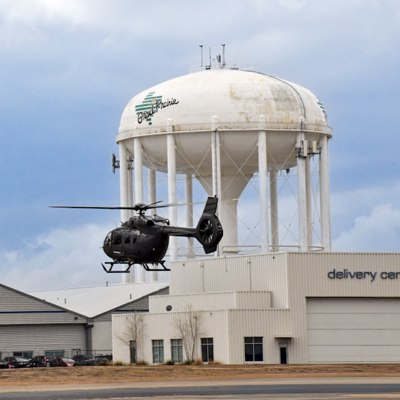
Airbus is positioning an unmanned MQ-72C Lakota derivative for the US Marine Corps’ Aerial Logistics Connector competition and has completed another series of autonomous flight tests using the H145 platform as a surrogate. The latest events at Airbus’ Grand Prairie, Texas facility focused on the practical bottleneck for uncrewed rotary-wing operations: perception-driven landing-zone assessment and decision-making under uncertainty. Airbus reports the aircraft could scan a landing zone while in flight, detect obstacles, and autonomously select an alternate landing point if required, with object detection spanning from SUV-sized obstacles down to items described as a pelican-case.
The test architecture underscores a modular, partner-integrated autonomy stack rather than a bespoke, single-vendor solution. Shield AI provided its Hivemind autonomy software, L3Harris supplied a modular digital backbone, and Parry Labs contributed edge computing and ground-control stations. Airbus executives framed perception systems as decisive for fielded unmanned logistics, while Shield AI emphasized “scalable autonomy” across rotary and fixed-wing platforms without custom redesign, aligning with the Marine Corps’ contested-logistics emphasis and the broader US DoD push to reduce risk to aircrews in resupply missions.
Notably, Airbus officials also signalled an intentional growth path beyond logistics. While the declared priority remains an aerial logistics platform for the Marine Corps, Airbus said discussions with other customers and partners suggest an opportunity to expand the mission set to include “launched effects,” a formulation typically associated with weaponized payloads, loitering munitions, or deployable effects from an airborne truck. If pursued, this would pull the Lakota Connector concept toward an armed or weapon-enabling derivative and raise integration questions around stores carriage, power/thermal management, certification, rules of engagement, and survivability trade-offs on a relatively light platform.
For Europe, the programme is relevant less as a near-term procurement cue and more as a reference case for requirements-writing and industrial strategy. If the Marine Corps validates uncrewed rotary-wing logistics at scale, European services facing dispersed basing and sustainment challenges—particularly on NATO’s northern and eastern flanks—will come under pressure to accelerate comparable capabilities. Airbus’ work also demonstrates how European primes can leverage US partner ecosystems (autonomy software, mission systems, edge compute) to mature products quickly, but it equally highlights potential sovereignty and export-control dependencies that European ministries will need to manage if similar architectures are adopted domestically.
Airbus says next steps include improving perception to detect smaller, more operationally representative objects and continuing internal autonomy and integration flight tests through the year, indicating a maturation track that could converge with both logistics certification and any future weapon-enabling modularity.
Source: Defense One