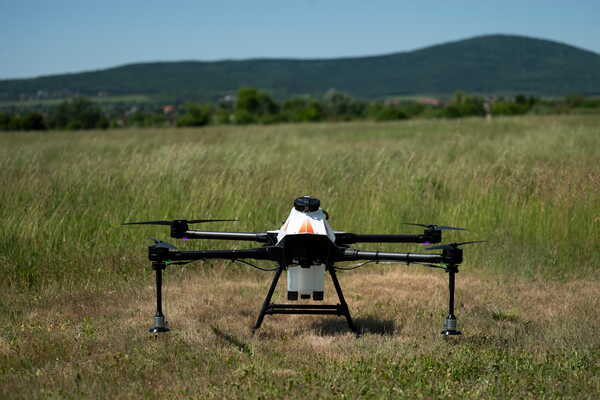
Avy upgrades ‘Avy Dock’ to enable fully remote Aera VTOL missions
Avy has unveiled an upgraded Avy Dock for its Aera fixed-wing VTOL, aiming to enable autonomous launch, landing and charging for fully remote, standby missions.


Key facts
- Avy unveiled an upgraded “Avy Dock” docking station for long-range, fully remote drone operations.
- The Avy Dock is developed for the Avy Aera fixed-wing VTOL drone.
- Avy states the dock enables autonomous launch, landing and charging without on-site personnel, aimed at inspection, monitoring and emergency response standby use cases.
3 minute read
Avy says it has unveiled an upgraded docking station, “Avy Dock”, aimed at enabling long-range, fully remote operations with its Avy Aera fixed-wing VTOL drone. According to the source, the dock supports autonomous launch, landing and charging without requiring on-site personnel, targeting professional users who need aircraft kept on permanent standby for inspection, monitoring, or emergency response.
From a European defence and security perspective, the significance lies in operational persistence rather than a new air vehicle: docking infrastructure is a key enabler for scalable unmanned operations when manpower, basing access, and response time are constraints. A fixed-wing VTOL paired with an autonomous dock can, in principle, provide broader-area coverage than typical multirotor “drone-in-a-box” solutions while still operating from confined sites—relevant to critical infrastructure inspection (pipelines, rail, power), coastal and border surveillance, and rapid post-incident assessment.
However, the source provides no performance figures, autonomy modes, environmental hardening, communications architecture, or cybersecurity and resilience details—factors that determine whether docked operations can be relied upon in adverse weather, RF-congested environments, or during deliberate interference. European procurement stakeholders should therefore treat the announcement as an indicator of product direction and market positioning, pending validation on availability, integration with UTM/ATM and national BVLOS regimes, and evidence of reliable autonomous recovery and charging cycles in operational conditions.
Source: Dronewatch.eu