Can an EU Drone Wall Prevent Russian Airspace Violations?
The concept of a 'drone wall' has emerged as a potential solution to counter Russian incursions into EU airspace. This strategy aims to bolster aerial defenses through the deployment of advanced drone technologies, enhancing surveillance and deterrence capabilities.

Key facts
- The EU is considering a 'drone wall' to counter Russian airspace incursions.
- Advanced drone technologies could enhance surveillance and defense capabilities.
- The feasibility of this strategy raises concerns about cost and geopolitical implications.
2 minute read
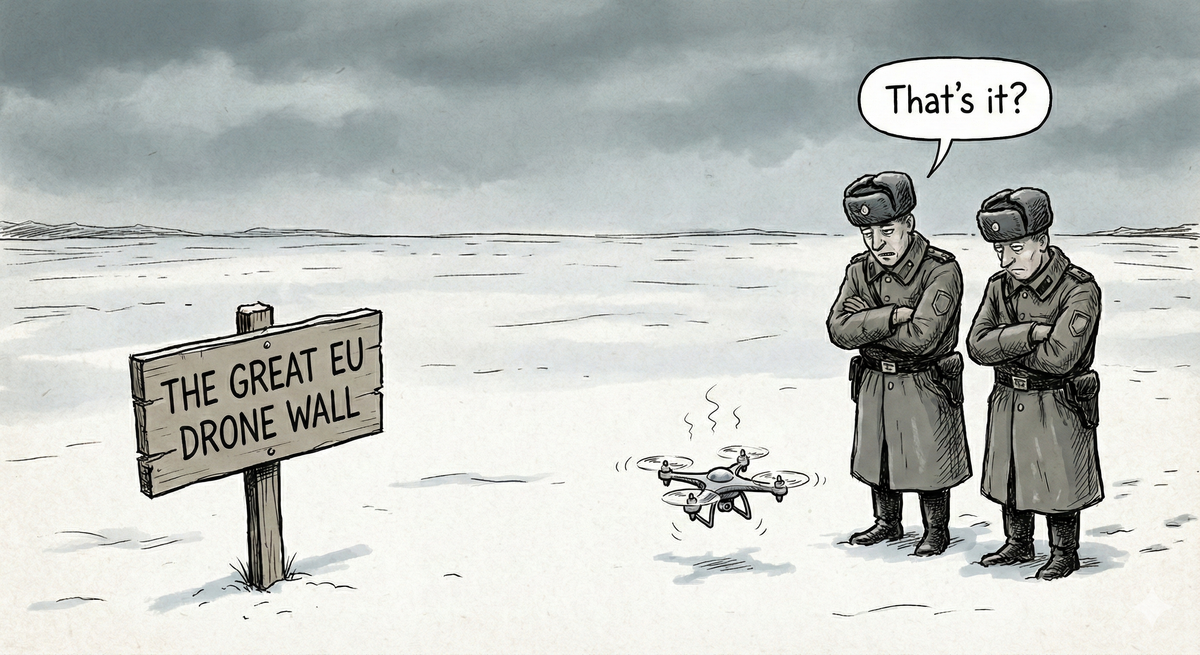
The concept of a "drone wall" along Europe's eastern flank is somewhat of a misnomer. It is less a physical barrier and more a federated digital shield—a complex network of national sensors designed to secure the airspace against a rising tide of intrusions. While the goal is to shorten decision cycles and create continuous tracking, the reality is a high-stakes technological cat-and-mouse game that will shape the next phase of modern warfare.
The Technological Challenge To be credible, this architecture must blend data from satellites and acoustic sensors with advanced micro-Doppler radar. The latter is critical; the system must be sensitive enough to distinguish a drone from a bird, a technical nuance that matters immensely when seconds count. However, the war in Ukraine has demonstrated that electronic warfare—jamming signals to sever the link between pilot and drone—is no longer a silver bullet. Adversaries are adapting with fiber-optic controlled drones that are immune to jamming, and AI-driven swarms that can navigate without GPS. Consequently, Europe cannot rely solely on "soft" electronic attacks; it needs "hard" kinetic interceptors and is chasing the elusive goal of effective drone-on-drone combat capabilities.
The Ethical and Legal Bottleneck The rapid evolution toward autonomous swarms—self-organized collectives of robots acting as a single entity—introduces a profound dilemma. To counter these swarms effectively, European defenses must be equally autonomous and incredibly fast. Yet, this creates a "black box" problem: how do we maintain "meaningful human control" over lethal force when the kill chain moves faster than human cognition? Harmonizing these rules of engagement with international humanitarian law is just as difficult as the engineering. We are attempting to build a system that is autonomous enough to stop a swarm, but predictable enough to keep humans accountable for life-and-death decisions.
Geopolitics and Governance Ultimately, the success of this project rests on governance and interoperability. A drone wall is useless if it cannot "speak" to NATO’s integrated air and missile defense systems. Data must flow through secure, sovereign clouds using common standards to avoid legal gaps at borders. While a visible drone wall signals resolve to Moscow, it risks being framed as escalation. To manage this, the EU must pair the build out with transparency measures and practical cooperation with non-EU NATO members. The costs will be high—not just in capital for munitions and sensors, but in the political effort required to unify a fragmented continent against a synchronized threat.