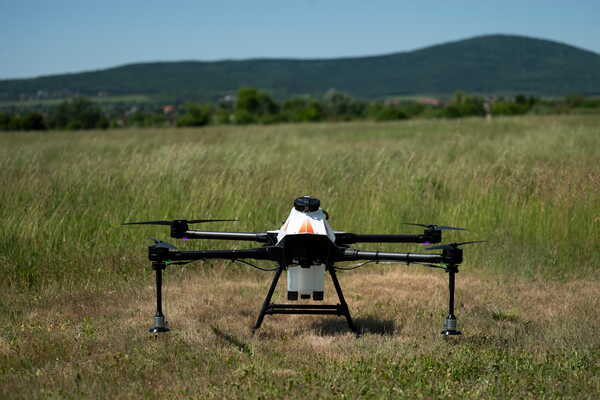
China’s ‘full-stack’ drone cities fuse rare earths, motors and mobilization
China is turning rare-earth cities into end-to-end drone ecosystems—magnets, motors, assembly and test infrastructure—while linking “low-altitude economy” parks to defence mobilisation.


Key facts
- Baotou is developing an end-to-end chain from rare-earth processing through magnets and motors to UAV/eVTOL assembly, supported by UAV testing, training and logistics bases.
- Chinese cities are co-locating rare-earth processing zones with component makers and drone/robotics parks as part of a push for “new quality productive forces.”
- Some “low-altitude economy” parks are being treated as dual-use mobilisation assets, including militia units organised around UAV reconnaissance and rapid airfield repair.
3 minute read
The reporting describes an emerging Chinese industrial template in which city governments deliberately assemble “full-stack” aviation and robotics ecosystems: rare-earth extraction and processing, magnet production, motor fabrication and final-system assembly are placed inside a single municipal footprint, supported by dedicated facilities for UAV testing, training and logistics. Baotou, historically central to China’s rare-earth sector, is portrayed as a mature instance where processed ores flow directly into magnets and motors and onward to drone, eVTOL and humanoid-robot production, with the Rare Earth High-Tech Zone acting as the anchor that accelerates iteration and reduces supply-chain friction.
Beijing’s strategic logic, as presented, is to treat rare earths not only as leverage over global markets but as the starting point for integrated industrial innovation. Rare-earth-enabled magnets and motors—associated with higher lift per watt and improved torque per kilogram—are positioned as enabling technologies for next-generation air systems. Local governments are therefore pairing processing zones with component makers and downstream integrators, with Mianyang cited as investing in permanent-magnet construction to extend a defence R&D reputation into production capacity.
The “low-altitude economy” (operations below 1,000 metres) provides the political-economic wrapper for rapid scale, spanning delivery, surveillance, tourism and urban air transport. China’s civil aviation regulator is cited as projecting a sector value up to RMB 2.5 trillion within a decade, while logistics drone routes already link inland provinces to Pearl River Delta networks. Several parks aim to become municipal ecosystems bundling magnets, motors, airframes, operations support and regulatory frameworks, explicitly reducing lead times.
The dual-use dimension is overt. Defence-affiliated commentary and local armed forces activity reportedly treat these parks as mobilisation resources; some parks shape their tenant mix to support defence tasks and have created militia units organised around long-range UAV reconnaissance and rapid airfield repair. This narrows the gap between commercial scale and wartime integration by keeping platforms, operators and maintenance ecosystems close to mobilisation structures.
Strategically, a RUSI finding is invoked: battlefield-drone output is often constrained less by airframes than by propulsion and actuation components. China’s municipal clusters seek to internalise these chokepoints. Their geographic distribution across coastal and inland areas also increases resilience against enforcement actions, energy limits or regional bottlenecks and complicates wartime disruption by strike or interdiction.
For Europe, the significance is twofold. First, dependence risks extend beyond raw rare-earth supply into the midstream and downstream (magnets, motors, actuators) required for scalable UAV and loitering-munition production, raising urgency for European sourcing, stockpiling and qualified industrial capacity. Second, China’s approach—integrated, fast-scaling, and mobilisation-linked—sets a competitive benchmark: European programmes that remain fragmented across borders and tiers may struggle to match cycle times and surge capacity unless procurement and industrial policy explicitly target propulsion/actuation bottlenecks and cluster-level integration.
Source: Defense One