Elistair Launches 24-Hour Dual-Payload Tethered Drone
French company Elistair has unveiled a new tethered drone capable of operating continuously for 24 hours without battery swaps. This dual-payload drone is designed for various applications, enhancing surveillance and operational capabilities in defense and security sectors.

Elistair Launches 24-Hour Dual-Payload Tethered Drone,
Key facts
- Elistair's new drone operates continuously for 24 hours without battery swaps.
- The dual-payload capability enhances its versatility for various applications.
- Tethered design ensures constant power supply and real-time data transmission.
2 minute read
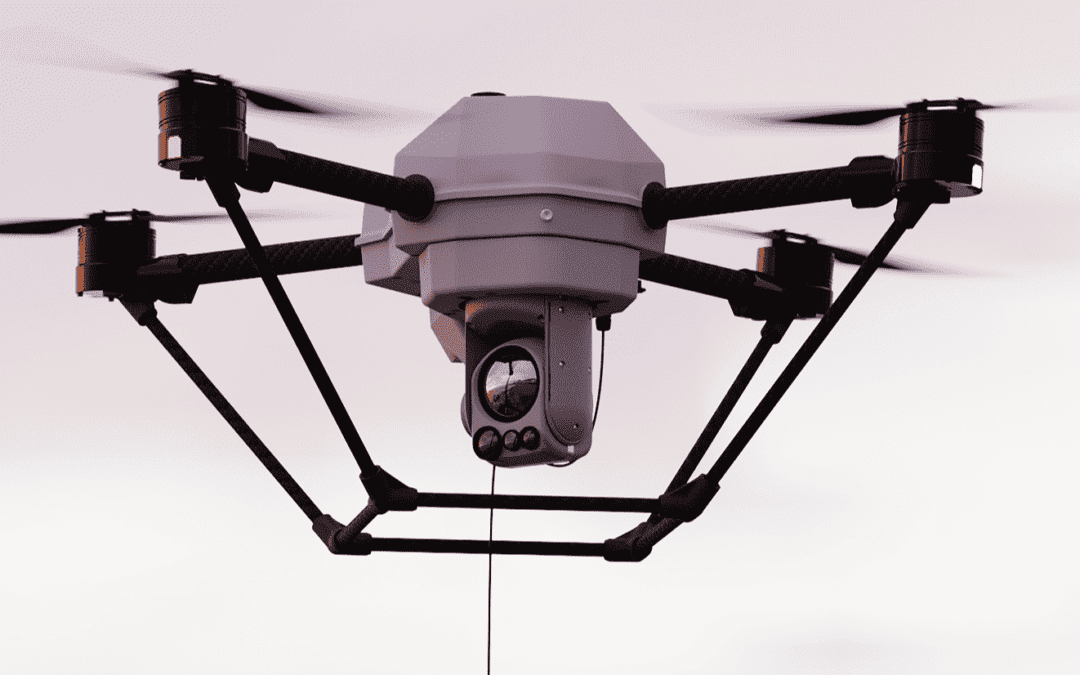
The unveiling of Elistair’s Khronos Dual Payload system at the Milipol security show in Paris highlights a mundane but critical shift in military surveillance: the move from platform performance to logistical endurance. By tethering a drone to a ground station, the French manufacturer trades range for unlimited power and secure data transfer. This offers a pragmatic solution to the "battery bottleneck" that plagues small unmanned aerial vehicles (UAVs), which typically require frequent landings to recharge. For NATO forces, the ability to maintain a 24-hour persistent eye over bases and borders without the operational friction of flight clearances or spectrum management represents a significant efficiency gain.
The system’s dual-payload configuration—combining an electro-optical/infrared camera with a tactical radio relay—allows it to function as a variable-height antenna. This creates a "pop-up" communications tower that simultaneously monitors its surroundings, a capability particularly relevant for units operating in complex urban terrain or GPS-denied environments. Strategically, tethered drones occupy a cost-effective middle ground between expensive, high-altitude aerostats and short-endurance multirotor fleets. They offer the persistence of balloons without the helium supply chains and can be deployed from a small vehicle in under two minutes, unlike cumbersome mast systems.
Industrially, the platform reinforces the push for European technological sovereignty. As France and Germany resist centralized EU coordination on the proposed "European Drone Wall," national champions offering interoperable, off-the-shelf solutions become increasingly important. A French-made system allows European armies to integrate persistent ISR (Intelligence, Surveillance, and Reconnaissance) into NATO architectures without the friction of third-country export controls. It also supports the scaling of defenses along the eastern flank, where the protection of energy facilities and coastal approaches requires constant, low-cost monitoring.
However, the operational limits are clear. The tether constrains the drone to a fixed radius and altitude, and the system remains vulnerable to physical attack and extreme weather. To be effective, these assets must be integrated into a layered defence network, paired with mobile counter-UAS systems and hardened ground stations to mitigate the risk of jamming or loitering munitions. Europe is moving toward a model of resilient ISR where locally powered, expendable assets free up scarce, long-range platforms for higher-priority tasks. In this context, the value of a drone is measured not by how far it flies, but by how long it can stay and watch.