Europe Develops Affordable Anti-Drone Rocket for Ukraine
In response to the ongoing conflict, Europe is developing a cost-effective anti-drone rocket designed to combat UAV threats in Ukraine. This innovative weapon disperses a cloud of steel balls, enhancing its effectiveness against enemy drones.

Key facts
- Europe is creating a low-cost anti-drone rocket for Ukraine.
- The rocket releases a cloud of steel balls to neutralize drones.
2 minute read
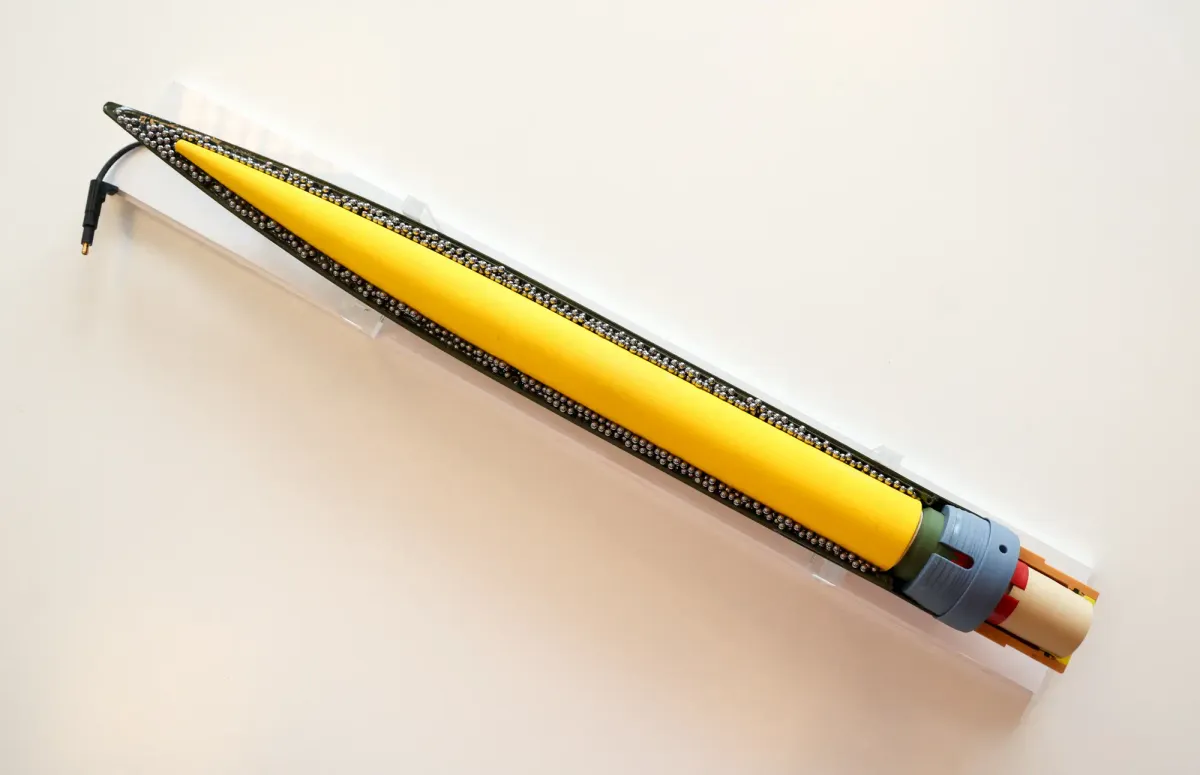
Europe is scaling up production of low-cost anti-drone munitions as the war in Ukraine accelerates demand for affordable air defenses. Thales Belgium has begun mass-producing its 70mm FZ123 airburst warhead, designed to release a dense cloud of steel pellets that shred drones mid-air.
Unveiled at Eurosatory 2024, the FZ123 adapts NATO’s standard 70mm rocket for modern drone warfare. Each warhead contains thousands of steel balls dispersed by a small explosive charge, creating roughly an 80-foot lethal radius capable of intercepting drones or swarms. Compared with missiles, these rockets offer a middle ground between cost, range, and scalability.
Ukraine’s forces, previously forced at times to rely on shotguns to shoot down drones at close range, are now fielding the FZ123 against Russia’s Shahed loitering munitions. Thales confirmed that Kyiv is already deploying the warhead and has requested far more than current production can supply.
While the company declined to publish exact pricing, 70mm rockets are estimated to cost a fraction of conventional surface-to-air missiles. Even guided variants remain roughly one-fifth the cost of missiles such as the AIM-7 Sparrow. Thales aims to produce 3,500 rockets this year and expand capacity to 10,000 annually by 2026, with potential to double output if suppliers keep pace.
The FZ123 can be fired from NATO-standard launchers mounted on trucks or helicopters, including Ukraine’s retrofitted Mi-8s. Laser-guided variants require operators to illuminate targets until impact, a limitation when drones fly high or during poor visibility. Still, the combination of adaptability, low unit cost, and ease of deployment makes these rockets an attractive option for frontline defence.
Amid rising drone incursions across Europe, states are watching closely. Executives at Thales describe an “unbelievable” surge in enquiries as militaries and security services reassess the cost calculus of air defence. Europe’s ability to counter mass drone attacks increasingly depends on solutions that blend affordability, precision, and volume with operational integration into broader counter-UAS networks, a challenge examined in coverage of Ukraine’s drone operations and the continent’s defence industrial debate in Europe’s rearmament analysis.
As production scales, logistics and supply chains will decide how quickly these rockets can relieve pressure at the front. If Europe can sustain high-volume manufacturing without price spikes, weapons like the FZ123 will shift tactical options on the battlefield by making quantity more affordable and by forcing adversaries to trade cost for capability.
You might also like to read...
 Mr. T (Curator)
 Mr. T (Curator)
 Mr. T (Curator)