Europe’s car industry pivots toward defence work as rearmament accelerates
Europe’s automakers and suppliers are increasingly positioning as defence subcontractors as primes like MBDA struggle to scale output amid Ukraine-driven demand.


Key facts
- MBDA says it is seeking high-volume manufacturing partners because it is not historically structured for mass production.
- FT reports Volkswagen is in discussions with Israel’s Rafael on producing support vehicles and equipment linked to Iron Dome; VW declined to confirm and reiterated weapons production is ruled out.
- Renault has a contract with Turgis Gaillard to develop military drones, signalling broader auto-industry entry into defence production.
3 minute read
Europe’s defence production surge is increasingly intersecting with the continent’s automotive downturn, as carmakers and suppliers explore defence contracts to stabilise employment and keep underutilised factories running. The underlying industrial logic is straightforward: European primes are receiving larger orders than they can fulfil, while automakers retain mature high-volume manufacturing cultures, supplier networks, and process discipline that defence production often lacks at scale.
MBDA CEO Eric Béranger framed the immediate constraint as structural: MBDA “knows how to make weapon systems” but has “not been structured to produce in mass,” prompting discussions with potential partners experienced in volume output. This is a notable signal from a major European missile house that ramp-up will increasingly depend on external industrial capacity rather than purely organic expansion—an approach with direct relevance to European governments pressing for faster delivery timelines against NATO capability targets.
The reported Volkswagen–Rafael Advanced Defence Systems discussions—focused on heavy-duty trucks, launchers, and generators supporting the Iron Dome missile defence system—illustrate a pathway where automotive plants contribute platform and support-vehicle production rather than “weapons” per se. Politically, it also demonstrates the sensitivity of brand, labour, and historical context: Volkswagen publicly ruled out weapons production and declined to confirm the report, even as it has previously indicated interest in military vehicle work and already has defence-adjacent activity via MAN’s joint venture with Rheinmetall for military logistics vehicles.
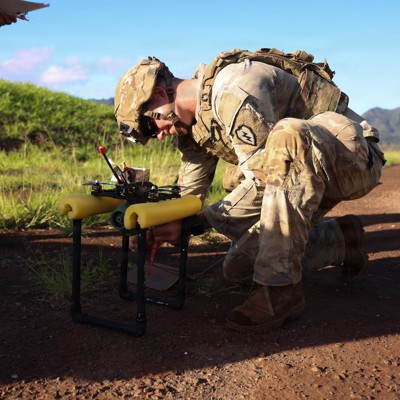
France provides a parallel example: Renault has a contract with Turgis Gaillard to develop military drones, indicating that the auto-to-defence migration is not limited to Germany or to ground mobility. For Europe, the strategic implication is that defence industrial capacity expansion may increasingly occur through cross-sector conversion—potentially faster than greenfield defence build-outs—but constrained by certification cycles, security requirements, union and workforce acceptance, and export controls (especially where non-EU partners such as Israel are involved).
Supplier economics are pushing the same direction. With a significant share of European automotive suppliers expecting losses and many reporting shifts toward defence-related production, the supply base may become a key lever for European resilience—if procurement frameworks, long-term demand signals, and IP/security arrangements are credible enough to justify retooling investment.
Source: POLITICO Europe