Fotokite and AeriaOne Unveil SEGI Partnership at Milipol Paris 2025
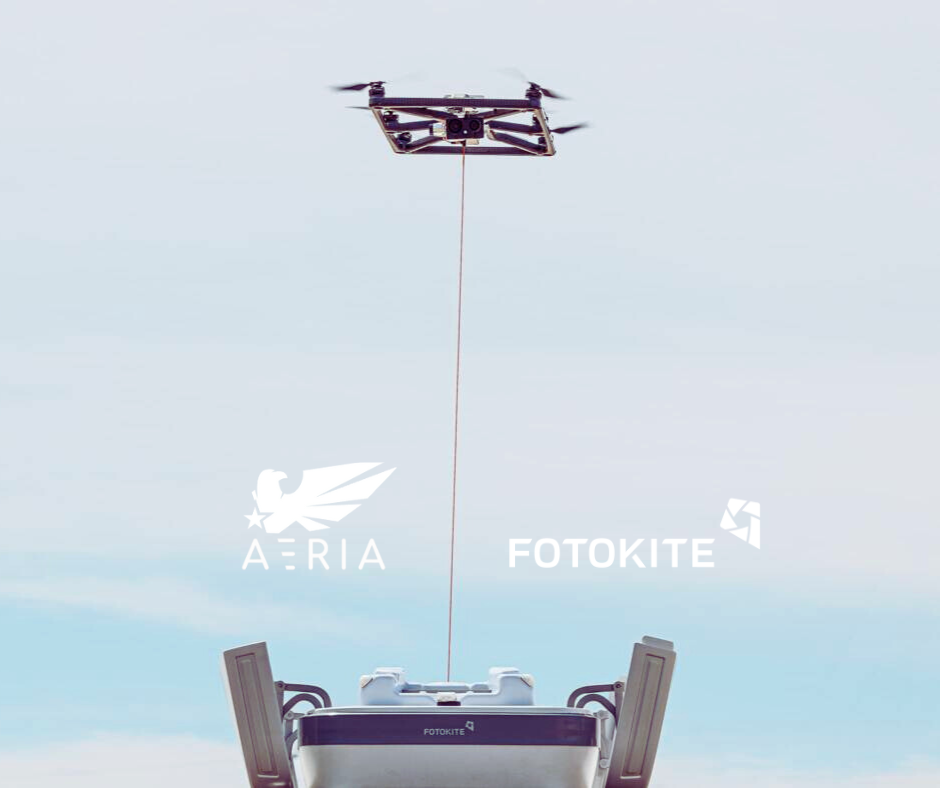
Fotokite and AeriaOne have launched a partnership at Milipol Paris 2025, introducing Swarm-Enabled Ground Intelligence (SEGI). This collaboration integrates autonomous aerial systems with augmented-reality interfaces, enhancing real-time intelligence for tactical units. The system aims to improve si
Key facts
- Fotokite and AeriaOne's SEGI system integrates aerial and ground intelligence.
- Operators can access live feeds and data hands-free via Falcon Lens eyewear.
- Field demonstrations are scheduled for 2026, targeting European defense sectors.
2 minute read
The strategic tie-up between Zurich-based Fotokite and British defense startup AeriaOne at Milipol Paris represents more than a simple hardware integration; it positions the "Swarm-Enabled Ground Intelligence" (SEGI) concept as a practical step toward sovereign, soldier-borne ISR for Europe. By pairing a persistent, actively tethered UAS with hands-free augmented reality eyewear, the partnership shifts intelligence consumption from handheld screens directly to the operator's field of view.
This transition promises to accelerate decision cycles and reduce cognitive load in degraded urban environments, effectively turning air support into an immediate reflex rather than a detached procedure. As Roland Raith, Fotokite’s Sales Director, emphasized during the launch, the goal is to allow commanders to "experience aerial intelligence as if they were standing beside the drone," transforming the technology from a manual process into an operational instinct.
For EU and NATO forces, the creation of a European, ITAR-free technology stack is operationally significant. It simplifies cross-border procurement, preserves national data jurisdiction, and lowers supply chain risk. Tethered platforms also mitigate the airspace and safety constraints that often ground free-flying drones in bases or crowded cities, providing assured power and a resilient data link with less reliance on GNSS or contested spectrum. The demand from ministries is clear: they need systems that multiply situational awareness without multiplying complexity.
The hard work, however, lies in the integration. To be truly useful at the brigade level and below, SEGI will need clean "hooks" into national command-and-control systems, blue-force tracking, and federated data services. Edge processing and on-device AI are critical to keeping bandwidth manageable, while the Falcon Lens interface is designed to limit training hours by making complex data intuitive. Tammam Shaibani, CEO of AeriaOne, noted that the engineering focus was on merging the aerial and ground domains into "one sensory field," ensuring that the flood of tactical data does not overwhelm the user.
Looking ahead, the roadmap signals ambition beyond a single mast-style UAV. If the system can orchestrate multiple aerial nodes and ground sensors as planned for the 2026 demonstrations, it could enhance convoy overwatch and rapid incident mapping. While this raises policy issues regarding spectrum allocation and data privacy, it aligns perfectly with Europe's push for interoperable, human-centric force digitization. Ultimately, the partnership reflects a broader shift in European defense: a move away from raw data volume toward "unified perception," closing the gap between the sensor and the decider.