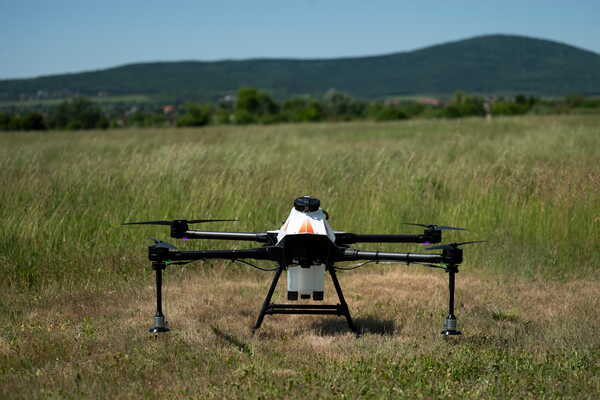
French Drone Manufacturers Pursue Opportunities in Ukraine Amid Funding Concerns
French drone manufacturers are exploring potential contracts in Ukraine, driven by the ongoing conflict and the need for advanced aerial capabilities. However, uncertainty surrounding funding and support from the French government poses challenges for these companies.

Key facts
- French drone makers are targeting contracts in Ukraine amid ongoing conflict.
- Uncertainties regarding government funding could hinder these efforts.
- The demand for UAS has surged due to the war, highlighting their strategic importance.
2 minute read
For the engineers and executives of France’s drone industry, the war in Ukraine has transformed from a distant geopolitical crisis into an immediate, high-stakes industrial reality. Ukraine is no longer viewed simply as a client for surplus inventory, but as the world's most grueling testing ground, a laboratory where combat-proven status is earned in blood and broken circuitry. As French manufacturers race to adapt, they are finding that the war is rewriting the rules of defense procurement, prioritizing affordable, disposable platforms over the exquisite, bespoke systems that have long defined European military engineering.
The reality on the front lines is brutal and fast-paced. As Jean-Marc Zuliani of EOS Technologie noted during recent high-level meetings in Paris, the challenge is not merely fulfilling a wish list but ensuring products can evolve day by day. In the Donbas, a drone’s lifespan is measured in sorties, not years. This demand for "attritable" platforms - systems cheap enough to lose without strategic consequence - requires a radical shift in mindset. Manufacturers must move toward modular designs and rapid software refreshes to survive the intense electronic warfare that renders static technologies obsolete within weeks.
However, this shift requires a level of agility that French financing has struggled to match. While companies like Delair and Alta Ares have technology capable of intercepting Iranian-made Shahed drones or conducting surveillance under jamming, they face a crippling uncertainty regarding funding. The transition from prototype to mass production requires working capital and predictable orders, commodities that remain scarce as Paris debates budget priorities. The industry is currently caught in a paradox where the technology is ready to deploy, but the financial machinery needed to scale it up is lagging behind British and German competitors who have been faster to capitalize projects.
To bridge this gap, the strategy is shifting toward localization. The most effective contract is no longer a shipment of crates across the border, but a partnership that establishes final assembly and repair hubs inside Ukraine. This approach solves multiple problems at once: it bypasses the sluggish pace of export licensing, reduces the cost of delivery, and creates a tight feedback loop where battlefield data drives immediate engineering tweaks. For Ukrainian operators, the priority is clear - they need firms that can train staff at scale and guarantee high sortie rates, regardless of where the hardware originated.
Yet, the implications extend far beyond the immediate conflict. There is a profound anxiety in Paris that if French firms hesitate, the market—and the standards for the next generation of warfare - will be consolidated by Turkish, American, and Ukrainian producers. To prevent this, European supply chains are being rigorously scrubbed of U.S. and Chinese-controlled components to avoid licensing delays and security vulnerabilities. The goal is a credible, autonomous European drone pillar that can reduce reliance on non-European suppliers.
Ultimately, the contest playing out between Paris and Kyiv is about more than just sales; it is a struggle to define the future of European airpower. The strategic prize is an industry capable of surging production during a crisis, moving away from slow, heavy platforms toward a faster, cheaper, software-led force. While the immediate metric of success is survivability against Russian jamming, the long-term victory belongs to those who can harmonize the desperate speed of war with the deliberate pace of industrial policy.