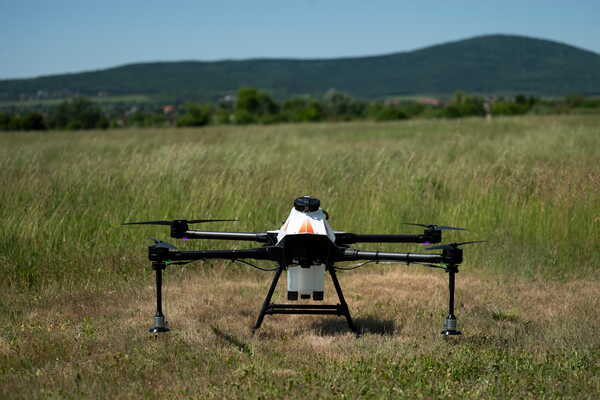
German Researchers Develop Drone Defense Strategies at Former Airfield
At a secluded airport in Germany, researchers are exploring innovative methods to counter the rising threat of drones, particularly those suspected to be of Russian origin.


German Researchers Develop Drone Defense Strategies at Former Airfield,
Key facts
- Researchers at Cochstedt airport are testing drone defense systems.
- Germany faces increased drone incursions, particularly from suspected Russian UAVs.
- Innovative countermeasures include nets, jamming, and GPS spoofing.
2 minute read
At a secluded airfield in Saxony-Anhalt, once used for holiday flights, Germany’s National Test Centre for Unmanned Aerial Systems is quietly becoming a frontline in Europe’s race to defend against drones. The site, operated by the German Aerospace Centre (DLR), allows researchers to experiment with detection and interception methods normally banned at civilian airports — from radio jamming to high-energy lasers.
The facility’s isolation and flexible regulatory framework make it ideal for testing technologies to counter both hostile and accidental drone incursions. Germany has faced a wave of unidentified UAV sightings, some suspected of Russian origin, over military and industrial sites. The federal government recently granted police new powers to shoot down drones, but scientists at Cochstedt are focusing on less destructive methods such as nets, “hunter drones,” and GPS spoofing to neutralize targets safely in populated areas — a direction aligned with Denmark’s call for advanced counter-UAS systems.
Researchers led by Johann Dauer and Daniel Suelberg are evaluating a range of sensors, cameras, and radar systems to determine which combinations provide the best protection for airports and public events without overwhelming budgets. Their task reflects a broader European dilemma: how to scale affordable counter-drone systems as threats evolve faster than procurement cycles — a challenge mirrored in Europe’s broader rearmament debate.
Drone incursions like the 2018 Gatwick Airport disruption have shown how even civilian incidents can paralyse airspace. With sightings now reported almost daily, Interior Ministry officials estimate civil drone defence spending could reach hundreds of millions of euros. At Cochstedt, teams are racing to keep pace with rapid innovation seen on Ukraine’s battlefields, where drones are evolving faster than defences can adapt.
As Dauer put it, Germany faces “pressure to innovate” while keeping defences cost-effective. The challenge is to ensure that protecting the skies from low-cost drones does not itself become prohibitively expensive — a principle at the heart of the European Defence Readiness Roadmap 2030.
you might also enjoy reading...
 Mr. T (Curator)
 Mr. T (Curator)
 Mr. T (Curator)