Helsing Acquires Blue Ocean to Enhance Maritime Autonomous Capabilities
Helsing's acquisition of Blue Ocean aims to bolster its Maritime Defence Programme by integrating advanced autonomous underwater vehicle technology, enhancing capabilities for underwater ISR operations in Europe and AUKUS regions.

Key facts
- Helsing acquires Blue Ocean to enhance autonomous underwater vehicle capabilities.
- The integration aims to boost underwater ISR operations for European and AUKUS navies.
- Helsing's SG-1 Fathom glider has already been tested successfully in military exercises.
3 minute read
In the opaque, pressure-crushed domain of anti-submarine warfare, the strategic calculus is shifting from the hull to the algorithm. For decades, NATO’s mastery of the North Atlantic relied on a finite number of exquisite, manned platforms hunting their peers. But the sabotage of the Nord Stream pipelines and the increasing vulnerability of seabed data cables have exposed the limitations of this high-cost, low-density approach. It is fitting, then, that Helsing, a European defence-AI unicorn, is in the process of acquiring Blue Ocean, a specialist maker of autonomous underwater vehicles (AUVs). The deal signals a deliberate push to vertically integrate artificial intelligence with hardware manufacturing, aiming to flood the GIUK gap and the High North with "attritable" sensors that can be lost without strategic penalty.
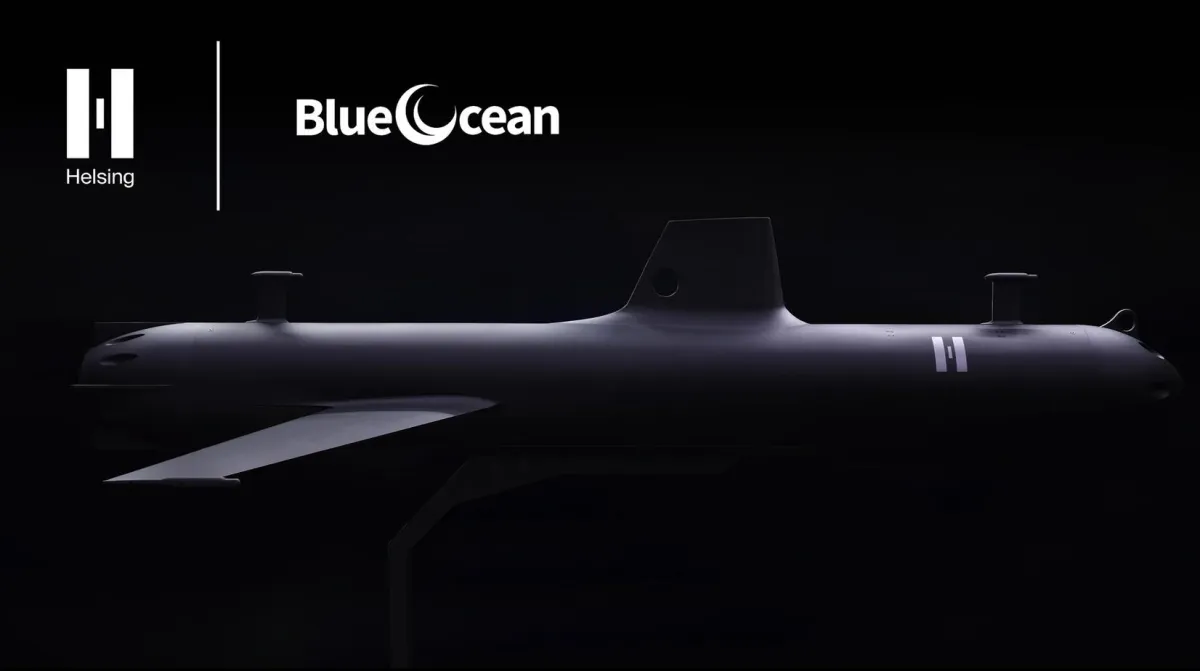
The acquisition, which is subject to regulatory approval, will see Blue Ocean’s hardware teams in the UK and Australia folded into Helsing’s software-first ecosystem. The industrial logic is to shorten the loop between code and kinetic capability. While Europe has strong incumbents in maritime engineering—notably in France, Norway, and Sweden—it has lagged behind the United States in the tempo of uncrewed system deployment. By purchasing a specialist builder, Helsing aims to bypass the friction of integrating third-party hardware, moving rapidly from trials to programmatic buys. This was foreshadowed earlier this year with the launch of the SG-1 Fathom glider and its subsequent testing at the BUTEC military range in July; the acquisition is the industrial corollary to that operational proof of concept.
For NATO commanders, the promise is one of "mass." Gliders like the Fathom offer endurance and sensing reach, but their true value lies in numbers. A network of autonomous systems, powered by edge AI, can provide continuous coverage of critical chokepoints and seabed infrastructure, cueing expensive frigates and P-8 Poseidon aircraft only when a threat is confirmed. This allows for a "deterrence by denial" posture around energy links and data cables, a mission that is currently too resource-intensive for manned fleets. The integration of Blue Ocean’s manufacturing capacity—aligned with Helsing’s recent announcement of a £350m investment in a "Resilience Factory" in Plymouth—suggests a move toward the kind of scale required to make this vision credible.
The geopolitical footprint of the deal is equally significant. With operations in the UK and Australia, the merged entity is positioned to supply AUKUS partners with an "ITAR-light" supply chain, easing the export of sensitive capabilities within the coalition. This aligns with NATO’s push for standardized data formats and underwater command-and-control architectures. Yet, the transition to a robotic seabed is not without risk. The hard problems ahead are governance and integration: deconflicting autonomous swarms in busy waterways, hardening them against cyber threats, and fusing their data into a coherent NATO maritime picture. Ultimately, however, the gamble is that the future of the underwater battlespace belongs to those who can iterate their software fastest. Europe’s defence industry is slowly pivoting from bending metal to training models.