Helsing and ARX Robotics: Software Meets Tracks
The partnership integrates Helsing's AI with ARX Robotics' UGVs to digitize land warfare, accelerating reconnaissance and strike capabilities. This aims for technological superiority over adversaries by reducing human latency in the kill chain.

Key Facts:
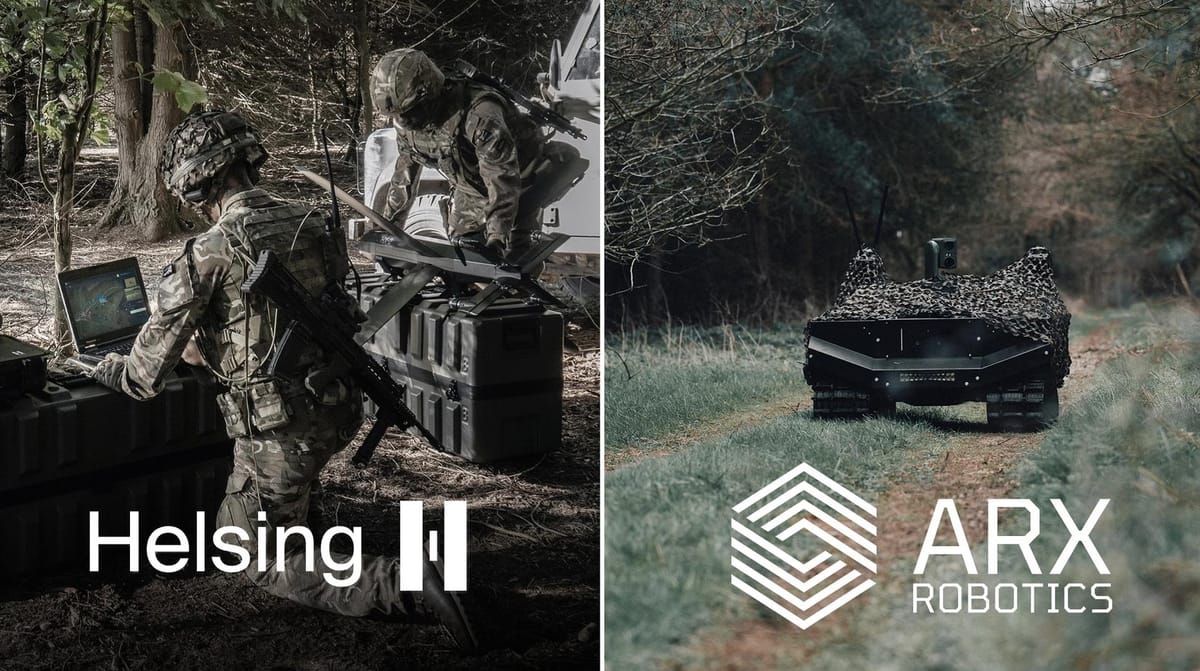
- Helsing and ARX Robotics have formalized a partnership to integrate AI-driven target recognition into unmanned ground vehicles (UGVs).
- The collaboration targets the "analogue" land domain, focusing on joint development projects in Germany, the United Kingdom, and Ukraine.
The land domain has long been the laggard of military digitisation. While air and naval forces have spent decades integrating sensors and shooters, ground warfare remains stubbornly analogue, defined by heavy armour, voice radios, and human latency. The September 9th announcement of a partnership between Helsing, a defence-AI unicorn, and ARX Robotics, a maker of modular ground drones, signals a determined effort to close this gap. By grafting advanced software onto cheap, scalable hardware, the collaboration aims to build a reconnaissance and strike network capable of operating at machine speed.
The logic of the deal is derived directly from the attrition rates seen in Ukraine. High-value, manned platforms are increasingly vulnerable to cheap loitering munitions; the solution is to flood the zone with "software-defined" systems that are expendable yet intelligent. ARX provides the chassis—unmanned ground vehicles (UGVs) capable of traversing mud and rubble—while Helsing provides the neural networks. The integration of AI allows these robots to navigate autonomously and, crucially, to detect and classify targets without constant operator input. This creates a "sensor-to-shooter" loop that is measured in milliseconds rather than minutes, allowing European forces to strike faster and from safer stand-off distances.
Industrially, this represents a maturing of the European defence tech ecosystem. Rather than waiting for unwieldy, multinational state procurement programs, two private entities are aligning their roadmaps to deliver capability across three specific jurisdictions: Germany, the United Kingdom, and Ukraine. This triangular focus is pragmatic. It leverages German engineering, British doctrinal flexibility, and the immediate, blood-bought feedback loops from the Ukrainian front line. It also attempts to solve the fragmentation of European land forces, where disparate radio systems and data standards often make cross-border cooperation a logistical headache.
Ultimately, this partnership is a bet on the future of mass. If European armies cannot match the sheer numbers of potential adversaries, they must win on processing power and coordination. The goal is to move from a collection of isolated platforms to a cohesive, digital kill web. By automating the dull, dirty, and dangerous work of reconnaissance and resupply, the alliance between Helsing and ARX suggests that the future of European land power will be defined less by the thickness of a tank’s armour, and more by the quality of its code.