Helsing Launches AI-Driven Submarine-Hunter Factory in Plymouth
Helsing opens its first UK Resilience Factory in Plymouth, focusing on autonomous underwater gliders to enhance maritime defense capabilities. The facility aims to create high-skilled jobs and strengthen European security through advanced AI technologies.

Key facts
- Helsing's factory will produce autonomous underwater gliders to enhance maritime defense.
- The facility is expected to create hundreds of high-skilled jobs in the South West.
- The initiative is part of a £350 million investment to strengthen the UK's defense capabilities.
2 minute read
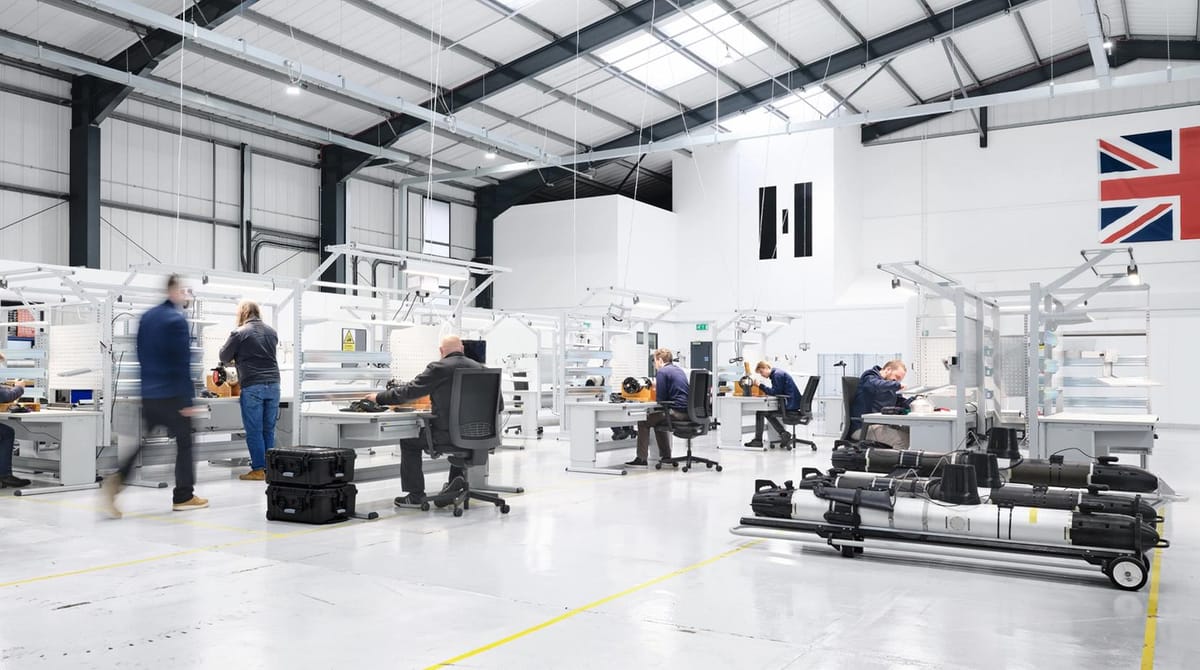
The opening of Helsing’s "Resilience Factory" in Plymouth on November 19th marks a quiet but significant evolution in British naval strategy. By commencing the mass production of the SG-1 Fathom, an autonomous underwater glider, the UK is moving away from a singular reliance on "exquisite" multi-billion-pound platforms towards a model of distributed, expendable mass. The facility, established under the diplomatic cover of the 2024 Trinity House agreement between Britain and Germany, represents a £350m bet that the future of the North Atlantic will be defined not just by the thickness of a frigate’s hull, but by the density of its sensor network.
The operational logic is driven by the widening gap between threat and capacity. Russian submarine activity in the Atlantic and the High North has reached post-Cold War peaks, yet NATO’s anti-submarine warfare (ASW) assets remain finite and expensive. The SG-1 Fathom addresses this asymmetry by offering a low-cost, long-endurance picket line. Powered by buoyancy changes rather than a propeller, these gliders can patrol for months, using Helsing’s "Lura" AI platform to process acoustic data at the edge. By classifying threats autonomously and cueing high-value assets like P-8 Poseidon aircraft only when necessary, they allow commanders to reserve their premier hunter-killers for the prosecution phase, rather than exhausting them on the search.
Industrially, the Plymouth facility signals the return of "sovereign resilience" to the heart of defence planning. For decades, Western procurement prioritised efficiency and global supply chains; the war in Ukraine has brutally exposed the fragility of that approach. By concentrating design, integration, and manufacturing in a domestic "Centre of Excellence," Helsing shortens the loop between operational feedback and software updates. This "spiral development" model—where hardware is iterated rapidly and software is pushed over the air—is standard in Silicon Valley but radical for the Ministry of Defence. It also anchors critical skills in the South West, delivering a tangible "defence dividend" in the form of high-skilled manufacturing jobs that are insulated from global supply shocks.
Success, however, will depend on integration. A glider is only as useful as the network it feeds. The challenge for policymakers is to ensure that the data generated by these autonomous constellations flows seamlessly into national and NATO common operating pictures, requiring rigorous standardization of data formats and robust cyber hardening. Furthermore, deploying swarms of autonomous systems in crowded European waterways presents environmental and deconfliction hurdles that must be navigated carefully. If these friction points can be overcome, Plymouth could become the blueprint for a new European maritime standard: one where deterrence is built on affordable, scalable, and intelligent mass.