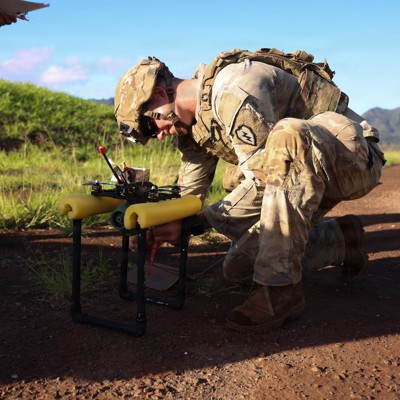
NATO weighs accelerated drone buys after Romania strike, Black Sea risks rise
NATO allies debated accelerated drone purchases for eastern-flank air policing after a Russian drone crash in Romania, with Black Sea infrastructure protection also rising on the agenda.


Key facts
- NATO ambassadors discussed accelerating drone purchases for air-policing over frontline member states after a Russian drone crash injured two people in Romania.
- Romania’s president said allies agreed to accelerate NATO projects on responding to drone threats, aiming for approval of support measures at the Ankara summit next month.
- Allies also debated Black Sea critical infrastructure protection, including Romania’s €4bn Neptun Deep gas project, and possible shifts of more air-defence assets to Romania.
3 minute read
NATO’s 32 ambassadors have discussed a proposal to accelerate drone purchases for alliance air-policing missions along the eastern flank, in a debate catalysed by the late-May/early-June spillover of Russia’s drone campaign into NATO airspace and territory. The immediate trigger cited by participants was a Russian drone crash into a Romanian apartment block that injured two people, followed by Bucharest’s appeal to fast-track NATO air-defence deliveries. In parallel, NATO has recently scrambled fighter aircraft against suspicious drones over Latvia and Estonia, underlining that the operational problem set is no longer confined to Ukraine’s battlespace but is increasingly a peacetime air-defence and escalation-management challenge for the alliance.
Romanian President Nicușor Dan stated after the meeting that allies agreed to accelerate NATO projects on responding to drone threats, with a view to approving support measures for affected allies at the Ankara summit next month. A separate diplomatic signal from the closed-door session was the push to bring “concrete initiatives” on drones to the July 7–8 leaders’ summit. The unresolved point is timing and mechanism: NATO owns few military assets, so any surge in drone capacity would likely rely on national procurement decisions shaped through NATO planning, with systems then potentially assigned to NATO command for agreed missions. For European procurement officials, this implies near-term demand pressure for ISR drones, counter-UAS sensing, and possibly armed overwatch capabilities within air-policing constructs, alongside questions over rules of engagement, airspace integration, and attribution thresholds for cross-border incidents.
The discussion also widened to Black Sea critical infrastructure protection, including Romania’s €4 billion Neptun Deep offshore gas project scheduled to come online next year. Diplomats said allies weighed whether NATO’s military command should do more to monitor aerial and naval drone threats to such installations. Separately, national military officials meeting at NATO’s military command in Mons reportedly expressed openness to shifting additional air-defence assets to monitor and eliminate drones over Romania. For Europe, the combined package points toward a more persistent, multi-domain posture in the Black Sea: a blend of drones for surveillance and cueing, paired with air-defence and fighter readiness for interception, driven by the recognition that low-cost UAS can impose disproportionate political and economic risk on frontline states and energy infrastructure.
Source: Politico.eu