NATO’s Vandier warns: Tech tempo now shapes deterrence
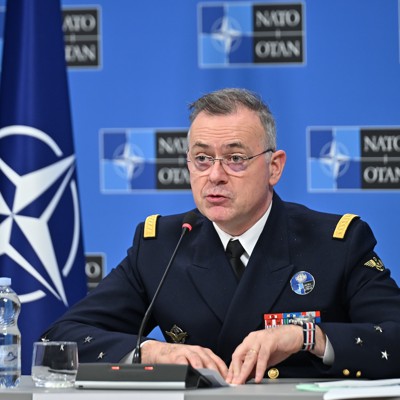
NATO’s ACT chief Pierre Vandier argues deterrence now hinges on proving the Alliance can iterate drones, C-UAS and AI-enabled warning as fast as Russia—or risk miscalculation.

Key facts
- ACT chief Adm. Pierre Vandier says NATO deterrence depends on proving rapid tech-to-fielding speed comparable to Russia.
- Vandier warns slow NATO transformation could enable Russian “miscalculation,” echoing 2022’s decision to expand the Ukraine war.
- NATO will run new counter-drone and layered defence integration experiments in Romania and Latvia; ACT is also advancing AI satellite early warning (SINBAD with Planet Labs) and LLM-assisted wargaming.
3 minute read
Adm. Pierre Vandier, who leads NATO’s Allied Command Transformation (ACT), is framing innovation tempo as a deterrence variable in its own right: the Alliance must demonstrate it can bring new technology into operational use as fast as Russia, or risk creating the perception gap that invites aggression. His warning is explicitly about miscalculation—if Moscow judges NATO’s transformation cycle to be too slow over the next decade, it may conclude the Alliance is less able to blunt an initial attack or adapt under fire, increasing the probability of a probe or escalation attempt.
The Ukraine war is presented as the proof case for “continuous reinvention” at the tactical edge. Vandier argues that purchasing new systems is insufficient if acquisition and industrial processes cannot sustain rapid iteration. His emphasis that “obsolescence is nearly immediate” is a direct critique of legacy procurement and prime-led development cycles that deliver capability in multi-year blocks, while the battlefield changes in weeks. For European defence officials, the implication is that deterrence credibility is now tied to whether member states can institutionalise field engineering, rapid certification, and agile contracting—particularly for UAS, C-UAS, and the software-defined layers that connect sensors to shooters.
Vandier counters the stereotype of NATO as immobile by citing REPMUS experimentation in Portugal, where NATO members fielded more than 70 autonomous systems in under three weeks in 2024, and a subsequent iteration concluding last spring that included more than 276 unmanned systems. He signalled that similar experiments are imminent in Romania and Latvia, focused on counter-drone systems and their integration into a layered defence architecture—an operationally relevant focus for the Eastern Flank where low-cost UAS and electronic warfare are already central to day-to-day force protection.
ACT is also pushing AI-enabled early warning and planning acceleration. Vandier referenced SINBAD, a project with Planet Labs to watch satellite imagery for changes in military activity, and indicated additional satellite services will be developed as NATO extends activity into the Arctic—an area where he acknowledged shortfalls. Separately, he described an effort to use large language models to compress wargame scenario development from 18 months by 60 people to less than two months with half the staff, aiming to make planning cycles responsive to rapidly changing threat conditions.
Source: Defense One