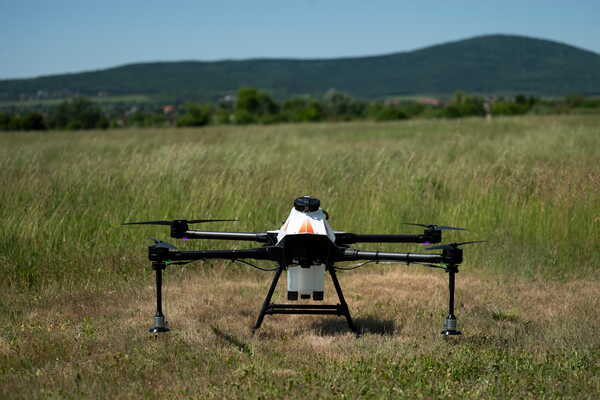
Nokia Enhances 5G Drone Capabilities with Amprius Battery Technology
Nokia has upgraded its 5G drone platform by integrating Amprius SiCore batteries, aiming to enhance operational efficiency and flight duration. This development underscores the growing importance of advanced battery technology in the drone sector.

Key facts
- Nokia's 5G drone platform now includes Amprius SiCore batteries.
- The upgrade aims to enhance flight duration and operational efficiency.
- Advanced battery technology is critical for modern defense and surveillance applications.
2 minute read
Nokia’s integration of silicon anode batteries into its drone-in-a-box platform is a quiet admission that standard lithium-ion chemistry has hit a ceiling for mission-critical operations. By selecting Amprius SiCore cells, the Finnish telecommunications giant is not merely chasing flight time; it is engineering a solution for the heavy power demands of the "Extra Long Range" (XLR) era. This shift signals a practical move toward networked UAS that can sustain high-bandwidth ISR and command links across European theaters, where the ability to linger on station with heavy LiDAR and thermal sensors is becoming the baseline requirement for border surveillance and critical infrastructure protection.
The operational logic is stark. As Dr. Kang Sun, CEO of Amprius, noted regarding the shift in the sector, "energy density and temperature control become decisive advantages" when unmanned systems are pushed into complex, autonomous roles. For commanders and industrial operators, the higher energy density of silicon anodes translates directly into payload margin. It allows platforms to carry the power-hungry 5G modules and edge computing processors needed to process data locally, rather than streaming raw feeds back to a vulnerable command post. This capability is essential for the "grey zone" monitoring required around the Baltics and the Mediterranean, where persistent target acquisition is often limited by the tyranny of battery life.
However, the supply chain implications create a complex strategic picture. Nokia’s choice of a U.S.-based battery partner underscores a broader Western effort to "scrub" supply chains of Chinese-controlled components, a dependency that Thomas Eder, Nokia’s Head of Embedded Wireless Solutions, has explicitly acknowledged remains a challenge for the industry. While sourcing from California bolsters security of supply compared to Asian alternatives, it forces European ministries to weigh performance against strict strategic autonomy. To mitigate this, defense planners will likely push for long-term service contracts and potentially second-sourcing arrangements that align with EU industrial ramp-up schemes.
This technical upgrade also aligns with the regulatory maturity of the European airspace. Nokia recently became the first manufacturer to receive a Design Verification Report (DVR) from EASA for a drone in this class, validating its safety for Beyond Visual Line of Sight (BVLOS) operations. Eder framed the company’s broader ambition clearly: "We are building an ecosystem that helps us with sensor supplies within Europe, and chip supplies, and silicon supplies." For NATO, this ecosystem is critical. Longer-duration electric UAS serve as a complement to manned ISR, provided they can bridge the gap between 5G commercial networks and resilient military mesh links.
Ultimately, the contest for air superiority on the frontier is becoming a contest of endurance and connectivity. Nokia’s pivot suggests that the future of European drone power will be defined by platforms that blend the reliability of telecom-grade networks with the raw stamina of next-generation chemistry. As the "drone wall" concept moves from political slogan to procurement reality, the ability to fly farther, carry more, and recharge faster will determine which systems become the backbone of the continent’s aerial defense.