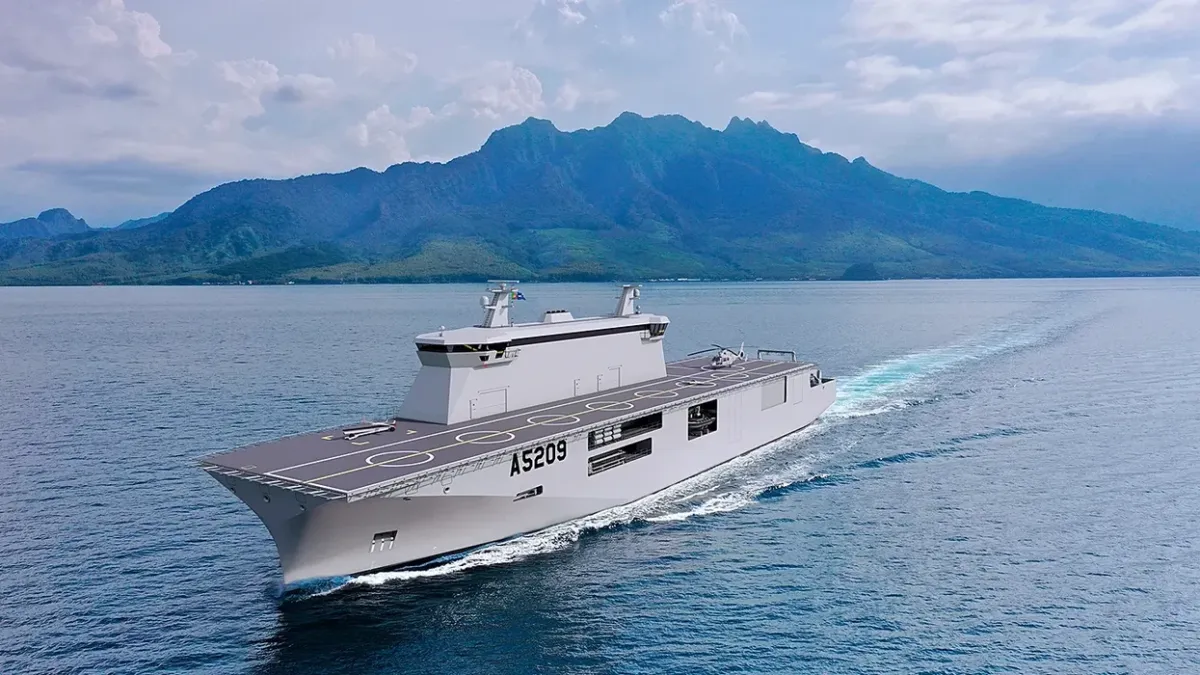
NRP D. João II: Portugal Redefines European Naval Doctrine via Modular Drone Mothership"
Portugal’s 132 million euro NRP D. João II drone carrier signals a shift in European naval strategy toward modular, unmanned systems.

Key Intelligence
- Modular Design: Reconfigurable within 7 days for roles ranging from ISR to SAR using 18 TEU mission modules.
- Tri-Domain Integration: Simultaneous operation of UAVs, USVs, and UUVs, including deep-sea ROVs reaching 6,000 meters.
- Cost Efficiency: Procurement at 132 million euros, representing a 90% cost reduction compared to conventional light carriers.
- Strategic Partnership: Joint maritime drone production agreement signed with Ukraine to integrate combat-proven tech.
3 minute read
The Portuguese Navy’s acquisition of the NRP D. João II, a 7,000-tonne Multifunctional Naval Platform (PNM), represents Europe’s first dedicated response to the rise of unmanned maritime warfare. Constructed at the Damen facility in Galați, Romania, the vessel is engineered to bypass the prohibitive costs and operational rigidity of traditional flat-decks. Instead of serving as a fixed-wing aviation platform, the D. João II operates as a mother ship for a triad of autonomous capabilities: the 94-meter flight deck supports unmanned aerial vehicles (UAVs) in vertical and short take-off configurations, while a stern ramp and side hangars facilitate the deployment of unmanned surface vehicles (USVs) and unmanned underwater vehicles (UUVs). This tri-domain integration allows for persistent surveillance and intervention across Portugal’s 4 million square kilometer maritime domain, the largest in the European Union.
Strategically, the project underscores a European move toward modularity. The ship’s ability to reconfigure for scientific research, search and rescue (SAR), or high-intensity surveillance within a seven-day window is enabled by a payload bay accommodating 18 standard 20-foot containers. These modules can house anything from hyperbaric chambers to hospital units and advanced command-and-control (C2) suites. This flexibility is vital for European states facing constrained budgets and evolving hybrid threats, such as the protection of critical undersea infrastructure. The project’s funding model—heavily reliant on the EU Recovery and Resilience Plan—demonstrates a growing trend of utilizing dual-use civilian-military funding to bolster national defense industrial bases under the guise of ecological and scientific research.
The vessel further serves as an industrial catalyst through the establishment of domestic and international production protocols. By partnering with Ukraine for the joint manufacture of maritime drones, Portugal is directly importing combat-proven attrition-warfare technology into the European procurement ecosystem. This collaboration, formalized in late 2025, ensures that the D. João II will be equipped with systems tested in high-intensity conflict environments, such as the Black Sea. For European aerospace and defense executives, the vessel represents a shift in the market: the demand is moving away from the ship itself as the primary weapon system and toward the modular, expendable payloads that give it life. As other European navies express interest in the Damen-built concept, the D. João II is likely to become the first in a new class of European 'sovereignty platforms' that prioritize digital-twin integration and AI-driven data processing over traditional broadside weight.
Source: AICEP