
Pentagon Starts Scaling Ground Robots—Following Ukraine’s Attritable Playbook
Ukraine’s mass UGV contracting is influencing US investment, highlighting a split between attritable low-cost robots and autonomy-heavy systems—with immediate implications for European procurement choices.

Key facts
- Ukraine says it contracted over 22,000 UGVs in the first seven months of 2026, nearly matching all of 2025
- US DoD committed more than $115 million to UGV projects in FY2026, per public records cited in the article
- USMC NMESIS uses UGV-based launchers firing two Naval Strike Missiles with ranges cited as over 100 nautical miles
3 minute read
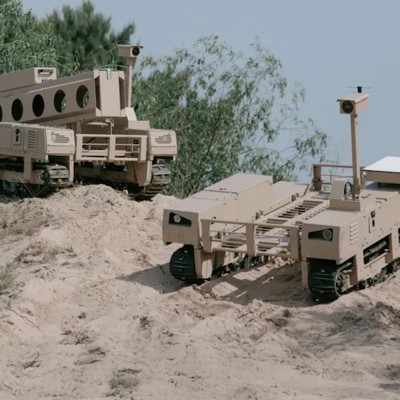
The source underscores a widening transatlantic convergence on the military utility of unmanned ground vehicles, driven primarily by lessons from Ukraine’s large-scale fielding rather than by peacetime concept demonstrations. Ukraine’s Ministry of Defense reports contracting more than 22,000 UGVs in the first seven months of 2026, roughly matching its total orders across 2025. The article frames this as a decisive indicator that ground robotics is transitioning from niche experimentation to mass procurement under high-intensity conditions, even if aerial drones still dominate by volume.
The operational constraint shaping designs is the increasingly comprehensive ability of both sides to detect and strike moving targets. That dynamic favours small, inexpensive and replaceable UGVs using commercial components, according to analyst Samuel Bendett. In Ukrainian service, UGVs are described as performing logistics and casualty evacuation, with platforms such as the TERMIT cited as capable of carrying up to 300 kg. The trendline is toward arming these systems: the article references a Ukrainian Droid TW 12.7 UGV with a .50-calibre machine gun used defensively in 2025, and notes Russia’s use of analogous ground systems including explosive “kamikaze” employment as early as late 2024.
In the United States, the Pentagon’s financial commitment remains modest compared with Ukraine’s scale, but is directionally significant. The piece cites more than $115 million in DoD commitments to UGV projects in FY2026. It highlights USMC NMESIS, which fields Naval Strike Missiles on UGV-based launchers for sea-denial missions in the Pacific, using a modified Oshkosh JLTV with autonomy packages from Forterra and Kodiak AI. It also points to procurement of Overland AI’s IBEX UGVs by the Marine Corps and the Army’s 75th Ranger Regiment for logistics and counter-UAS defence, alongside additional awards for autonomous breaching.
For Europe, the key implication is that two procurement models are emerging: a wartime-driven “attritable mass” approach optimised for rapid replacement and tolerance for losses, and a US-style push toward autonomy and higher capability for operations in communications-degraded environments. European land forces facing a Russia-centric high-intensity contingency will need to determine whether UGV investment should prioritise scalable industrial throughput and simple control architectures, or autonomy-centric programmes that may deliver superior independence from networks but at higher cost and longer timelines. The Ukrainian data point also strengthens the argument for European acquisition pathways that can place large orders quickly, integrate commercial components, and refresh designs rapidly as counter-UGV tactics evolve.
Source: Defense One