Poland Expands FlyEye UAS Procurement from WB Group
The Polish Ministry of National Defence has contracted WB Group for additional FlyEye unmanned aerial systems, enhancing its reconnaissance capabilities. This order reflects Poland's commitment to modernizing its defense technology amidst evolving security challenges in Europe.

Key facts
- Polish MND orders more FlyEye UAS from WB Group to bolster military capabilities.
- The FlyEye UAS is recognized for its versatility in reconnaissance operations.
- This contract is part of Poland's broader defense modernization strategy.
2 minute read
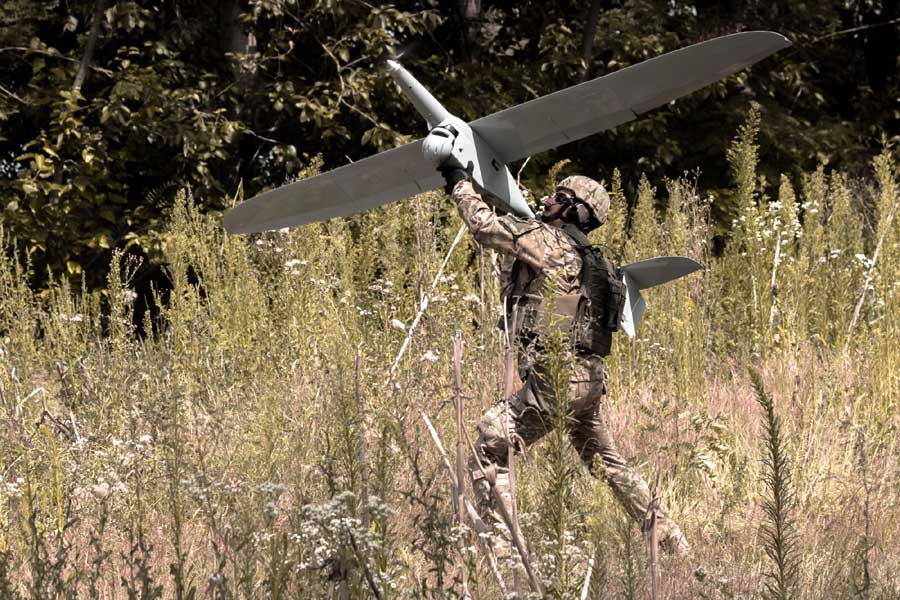
Poland has placed a new order for WB Group’s FlyEye reconnaissance drones, reinforcing its rapid modernisation drive and building a denser, layered intelligence, surveillance and reconnaissance network on NATO’s eastern flank. The hand-launched systems, proven in Ukraine as reliable artillery spotters and frontline scouts, give commanders rapid targeting data and a resilient link between manoeuvre units and fires. Their endurance and ease of deployment make them ideal for dispersed operations where speed and survivability outweigh sophistication.
Sourcing from a domestic supplier gives Warsaw critical advantages: short supply lines, faster sustainment, and control over data flows and software upgrades. The drones can be fielded in large numbers at battalion level, integrated with Poland’s existing digital fire control systems, and distributed across units to shorten the sensor-to-shooter loop. That integration raises the cost of Russian probing and improves reaction time in contested environments where electronic warfare and air defence are constant threats.
Strategically, the FlyEye deal fits Poland’s broader investment in scalable, interoperable drone fleets that complement higher-tier assets such as medium-altitude UAVs and satellites. It aligns with NATO and EU objectives to expand drone production capacity, standardise interfaces, and improve target cueing for both tube artillery and loitering munitions. The approach favours volume and interchangeability over bespoke systems, reflecting lessons learned from Ukraine’s attritional warfare.
For industry, steady Polish demand sustains the development of secure datalinks, autonomous control, and miniaturised sensors that can be exported across Europe. For NATO, it means more organic Polish intelligence coverage, reducing reliance on scarce high-end platforms and reinforcing deterrence along the alliance’s front line. The trend underscores Europe’s shift toward massed sensors, tighter kill chains, and deeper industrial resilience, where rapid fielding and domestic capacity become as decisive as range or endurance.
Source: European Security & Defence
You might also like...
 Mr. T (Curator)
 Mr. T (Curator)
 Mr. T (Curator)