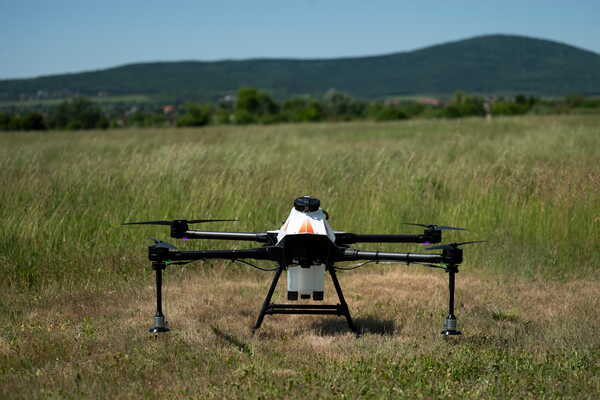
French Firefighters Test High-Pressure Spray Drone on 96-Metre Wind Turbine
Oise emergency services deployed a tethered Hercules 20 High-Dra multirotor at a Kallista Energy wind farm to demonstrate firefighting capabilities at turbine nacelle height.


Oise emergency services deployed a tethered Hercules 20 High-Dra multirotor at a Kallista Energy wind farm to demonstrate firefighting capabilities at turbine nacelle height.
Key Facts
- SDIS 60 (Oise fire service) conducted trial at Breteuil wind farm using a 240-bar high-pressure spray drone
- Hercules 20 High-Dra reached 96 metres with continuous water supply via ground-tethered hose, not onboard tank
- System maintained stable operation in 30 km/h winds with gusts to 50 km/h during demonstration
French emergency services completed a practical demonstration of a spray-equipped industrial drone for wind turbine firefighting at the Breteuil wind farm operated by Kallista Energy. The Oise fire and rescue service (SDIS 60) deployed a Hercules 20 High-Dra multirotor equipped with a 240-bar high-pressure spray system, reaching 96 metres—comparable to modern onshore turbine hub heights. Unlike conventional aerial firefighting drones with onboard water tanks, the Hercules 20 operates with a ground-tethered hose, enabling continuous spray operations without payload weight constraints. The system maintained stable flight in winds up to 50 km/h, a critical requirement for turbine fire scenarios where ignition occurs inside the nacelle dozens of metres above ground.
European renewable energy operators face growing pressure to address turbine fire risks as wind capacity scales across remote and offshore sites. Conventional ladder trucks cannot reach nacelle heights on modern turbines, and manual access via internal ladders exposes personnel to extreme danger during active fires. The tethered spray drone concept offers a middle ground: faster deployment than ground-based equipment, targeted suppression without crew exposure, and continuous operation unconstrained by drone endurance limits. France has deployed over 20 GW of onshore wind capacity, with nacelle fires remaining a low-probability, high-consequence event that insurance and grid operators monitor closely.
Forward signal: Expect European wind operators and emergency services to pilot tethered spray drones for turbine fire response over the next 12-18 months, particularly in regions with aggressive renewable build-out targets. Counter-argument: If tethered systems prove too cumbersome for rapid deployment or fail to deliver effective suppression at nacelle scale, operators may instead prioritise improved fire suppression inside turbines (sprinkler systems, inert gas) over external aerial response.
Source: Dronewatch.eu