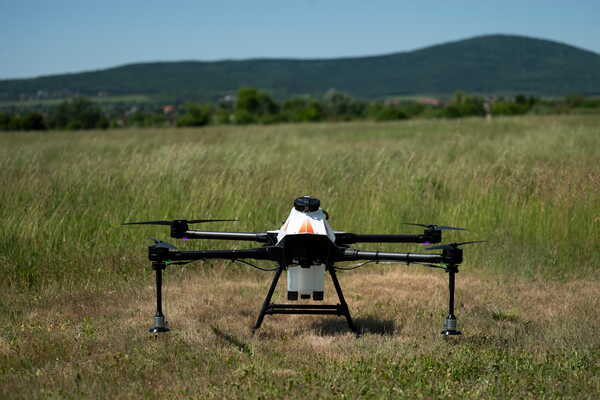
Sweden commits $437m to drones across all services, adds military satellites
Sweden will spend $437m on drones for all services—recon, EW, loitering munitions and maritime UxS—with deliveries targeted within two years, alongside funding for ~10 military satellites to boost unmanned systems and cruise missiles.

Key facts
- Sweden will spend 4 billion kronor ($437m) to acquire drones for all branches, including recon, EW, long-range loitering munitions, and maritime mine-clearance/surveillance drones.
- Defence Minister Pål Jonson said the drone systems should be delivered within two years.
- Sweden will invest 1.3 billion kronor in space capability, including around 10 military satellites to enhance unmanned systems and cruise missiles.
3 minute read
Sweden is allocating four billion kronor (about $437 million) to field drones across all branches of its armed forces, Defence Minister Pål Jonson announced in Stockholm. The portfolio explicitly spans reconnaissance drones, electronic-warfare drones, and long-range loitering munitions, alongside maritime drones intended for mine clearance and maritime surveillance. Jonson stated the drone systems should be delivered within two years, a timeline that implies compressed acquisition and integration cycles and a prioritisation of near-term operational utility over bespoke, longer-development solutions.
The investment is paired with a 1.3 billion kronor push into “space capability”, comprising around 10 military satellites. Jonson linked the satellite effort to improved effectiveness of Sweden’s unmanned systems and cruise missiles, underscoring the operational trend toward ISR-to-strike chains that rely on resilient communications and targeting support. For European defence planners, the combined drone-and-space package is notable because it treats space enablers as integral to uncrewed operations rather than a separate strategic programme, a model increasingly relevant as Russia’s electronic warfare and counter-ISR posture pressures NATO’s northern flank.
The announcement arrives amid broader Swedish air-defence reinforcement. Jonson referenced Sweden’s decision the previous day to invest 15 billion kronor in ground-based air-defence systems, and Sweden’s earlier plan to spend roughly $366 million on IRIS-T short-range surface-to-air missiles to protect against missiles, drones and combat aircraft. Together, these moves indicate Stockholm is balancing expanded uncrewed strike and sensing with layered defensive measures, anticipating a contested air environment where drones are both a primary tool and a primary threat.
Politically, Jonson framed the procurement in a wider European context, arguing that beyond the “growing threat from Russia” Europe must also contend with increased US unpredictability and therefore assume greater responsibility for Europe’s and Ukraine’s security. For European industry and procurement authorities, Sweden’s two-year delivery target and broad mission set will likely sharpen demand for rapidly producible UAS, loitering munitions, maritime uncrewed systems, and associated C2, EW, and satellite-enabled connectivity—areas where cross-border sourcing, common standards, and scalable production capacity are becoming decisive.
Source: SpaceWar (AFP)