Ukraine's AI Drones Transforming Warfare with Precision Strikes
Ukraine's integration of AI-driven drones is revolutionizing combat strategies, enabling precision strikes that surpass traditional artillery and showcasing the importance of UAS in modern warfare.

Key facts
- AI drones in Ukraine are outperforming traditional artillery in precision strikes.
- Real-time intelligence from drones enhances battlefield decision-making.
- The shift to drone warfare may redefine military strategies across Europe.
2 minute read
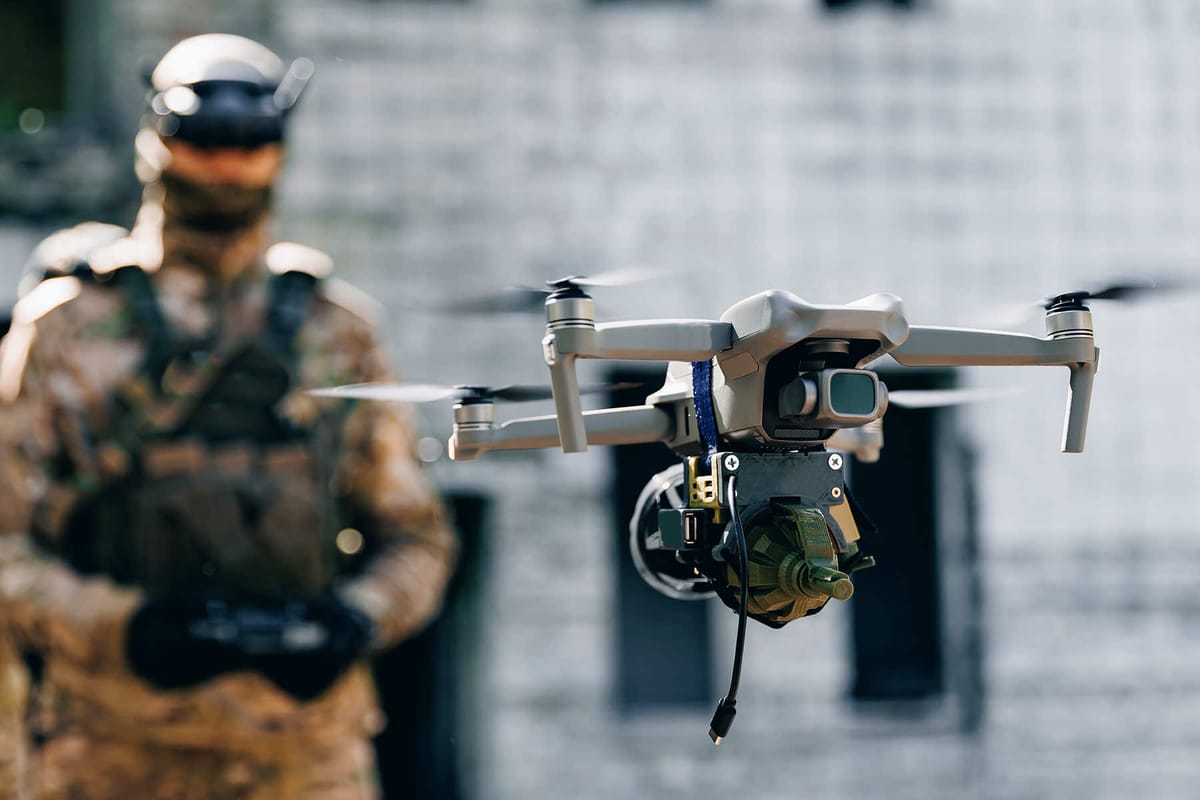
The Russian soldier had barely stepped from the trees when the Ukrainian reconnaissance feed sharpened and an armored silhouette bloomed on the operator’s screen. From a camouflaged position, Heorhii Volkov, who commands Yasni Ochi, Clear Eyes, of the 13th Khartiia Brigade, gave the order. A strike drone lifted from a site roughly 20 kilometers away. The radio link fluttered, the target lock did not. A red marker danced as the aircraft closed. Seconds later it dived. Follow-on drones swept in to confirm the hit and scan for survivors.
That sequence, detect, identify, strike, verify, has become routine in a war where the contest for better drones and smarter software never pauses. “Right now we mostly work along what I’d call the middle line, not quite a deep strike, but not the frontline either,” Volkov says. His unit’s task is to unpick logistics and prevent Russian units from massing. When Ukrainian crews began hitting 30 to 40 kilometers behind the line, he says, Russian artillery output fell as the networks that sustain it frayed. “Artillery can only work if all of its supporting elements work.”
Ranges shape every decision. The brigade focuses on targets 20 to 30 kilometers from the front, can reach to 60 when conditions are perfect, and treats 20 as the most reliable bracket. Wind, payload, and battery chemistry are constant constraints. So is terrain. Russian infantry moves in pairs or trios, hugging dugouts and forest cover. Motorbikes and quad bikes are harder to spot. Belgorod’s air defenses loom to the north, so reconnaissance rarely crosses the border. Operators often see a target only when it is already within range.
The work is dangerous and physical. Vehicles attract enemy drones, so crews dismount and hike five to seven kilometers with batteries and antennas on their backs. Ground robots could help, but there are not enough yet. On the screen, AI cues speed decisions when links degrade, though trees and glints from puddles can still fool the algorithms. Human checks remain essential.
What has changed most is scale. In 2022 the unit flew consumer Mavics with spare batteries and hand-carried memory cards. Now Starlink pushes live video, and a single hide can host six to eight aircraft with dozens of batteries. Volkov estimates drones deliver about 70 percent of strikes today, artillery perhaps 10 to 15, a stark inversion powered by cost and precision.
Success brings new problems. Volunteer energy has produced a thicket of designs and slow consolidation. Volkov wants interoperable standards, cheaper modular airframes, and faster approvals so equipment reaches crews in weeks, not months. He also warns against complacency. Russia adapts quickly, and he sees rough parity rather than an enduring edge. Ukraine’s advantage, he says, is managerial speed and a habit of constant iteration. To keep it, the improvisation of the past two years must become institutions that scale.