Ukraine’s EW reality is hardening US Army drone training and links
US Army officers warn that drones that look viable in testing can fail in Ukraine-like EW; resilient navigation, switchable C2 links and low-cost counter-UAS are now central priorities.

Key facts
- US Army officers say some US systems in Ukraine failed because training did not reflect real EW and drone-combat conditions.
- Priorities include GPS alternatives (visual/magnetic/radio/cellular) and C2 links that can switch between satcom, RF and cellular to resist jamming and interception.
- Fibre-optic tethered drones and low-cost counter-UAS (<$5,000) are highlighted as practical, scalable responses drawn from Ukraine’s battlefield practice.
3 minute read
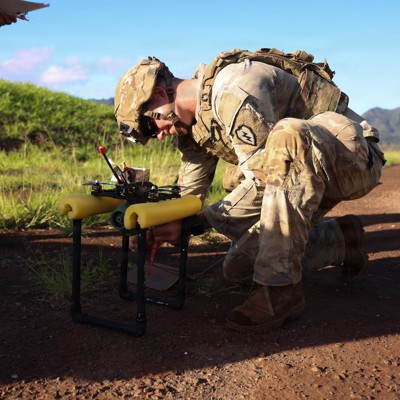
US Army leaders are signalling that the fastest path to battlefield-relevant drone mass is not simply procurement volume but forcing training, navigation and command-and-control architectures to match the harsh electronic-warfare conditions observed in Ukraine. Speaking at the AUSA Global Force Symposium in Huntsville, Col. Burr Miller of Security Assistance Group-Ukraine said he had seen “many U.S. systems” in Ukraine that failed quickly because they were not prepared for the environment, and urged industry to help build training that mirrors how drone warfare is actually being conducted—characterised by constant jamming, rapid counter-adaptation and aggressive exploitation of weak links.
The most explicit technical gap highlighted was dependence on GPS. Miller argued soldiers need credible alternatives including visual-based navigation, magnetic navigation, and the use of radio or cellular signals as fallbacks when GPS is unavailable or degraded. In parallel, drone command links must be designed for contested spectrum operations, with resilient, switchable pathways that can move between satellites, radio frequencies and cellular networks to reduce vulnerability to jamming. He also noted that in Ukraine he observed C2 links that were “easily intercepted,” with Ukrainian forces exploiting such weaknesses to capture and repurpose adversary systems—an implicit warning that datalink security and emissions discipline are as decisive as airframe performance.
Operationally, the Army expects its units to fight dispersed to avoid detection, while still maintaining coordination under constant electromagnetic surveillance. Col. Ryan Bell of the 101st Airborne Division’s 3rd Mobile Brigade Combat Team underscored that any emission can become a targeting cue: if formations “talk” or “put a signal out,” they can be seen and struck. This reinforces a European procurement implication: for NATO’s eastern flank and rapid reinforcement plans, drone and counter-drone capability must be integrated with low-probability-of-intercept/low-probability-of-detection communications, robust spectrum management, and realistic collective training in contested EW rather than peacetime range conditions.
Miller pointed to tethered fibre-optic drones as a pragmatic mitigation for jamming and interception, since the control path is physical rather than RF; the main defeat mechanism becomes physically locating and cutting the tether, trading range for link security. Finally, he echoed a broader US institutional push—intensified after creation of Joint Interagency Task Force-401—to harvest Ukrainian counter-UAS experience, including inexpensive systems reportedly under $5,000 that can defeat larger drone classes (Group 2–4). For Europe, this validates a shift toward cost-imposing, scalable counter-UAS layered with EW and kinetic effects, and raises urgency for joint doctrine and common procurement approaches that prioritise survivability in Ukraine-like spectrum conditions.
Source: Defense One