Ukraine’s robot assault playbook forces NATO to rethink ground-air autonomy
Ukraine’s reported robot-led assaults—and NATO ACT’s active studies—highlight Europe’s urgent need for EW-resilient navigation, interoperable C2, and supervisory control that lets one operator manage multiple air and ground robots.

Key facts
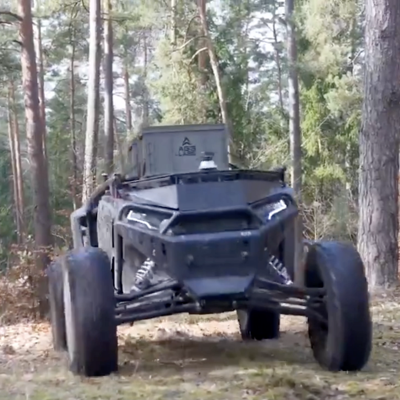
- Ukraine’s 3rd Assault Brigade claimed a July 2025 attack in which Russian troops surrendered to approaching explosive-armed UGVs, after FPV and ground robots struck fortifications.
- NATO Allied Command Transformation extended its Force Lethality Enhancement study and Task Force X is integrating ground robots into multidomain concepts.
- Key constraints are autonomy and navigation: FPV drones are often one-per-operator; UGVs typically require continuous control, while GPS jamming drives visual/terrain-matching alternatives.
3 minute read
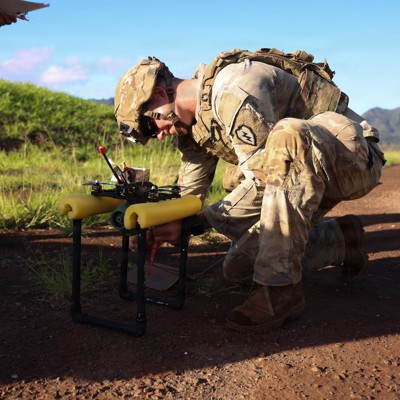
The article frames Ukraine as the live-fire laboratory for a doctrinal shift: assault tasks traditionally requiring infantry are increasingly being executed by combined teams of FPV aerial drones and explosive-armed UGVs. Zelensky publicised a July 2025 skirmish described by Ukraine’s 3rd Assault Brigade in which Russian troops reportedly surrendered when a ground robot approached a destroyed dugout, after aerial FPVs and ground robots attacked enemy fortifications. The brigade claimed the action was conducted without infantry and without Ukrainian losses, with survivors escorted back by aerial drones and taken prisoner. Zelensky added a scale signal—Ukrainian robotics companies conducting more than 22,000 frontline missions in three months—suggesting rapid iteration and mass employment rather than isolated demonstrations.
NATO is explicitly absorbing these lessons. Allied Command Transformation has extended a Force Lethality Enhancement study to generate practical force options and test them in realistic scenarios, and Task Force X is pursuing multidomain integration of ground robots under senior leadership at ACT. For European militaries, this implies near-term pressure to update assault doctrine, training and rules of engagement around manned-unmanned teaming and the management of robotic “systems of systems,” not merely the procurement of platforms.
Technical constraints remain decisive. FPV drones are still largely a one-operator/one-drone enterprise, albeit with partial autonomy such as waypoint flight, loitering and re-acquisition after brief communications loss. UGVs are portrayed as more demanding: reliable navigation in cluttered terrain is still difficult, forcing constant operator attention and tight coordination with aerial drone operators overhead. Ukraine’s parallel push to reduce dependence on GPS—through visual and terrain-matching and other AI-enabled navigation—reflects the realities of pervasive jamming and the need for resilient PNT in European high-intensity scenarios.
Russia’s robotic operations are characterised as high-volume but narrower in scope, centred on one-way attack drones (including Shahed-type systems) and some casualty evacuation, rather than taking positions. The Lancet, produced by ZALA, is cited as using map/imagery matching on final approach; the article argues this is “good enough” in Russian employment partly because Russian forces place less emphasis on collateral control and precise target discrimination. Ukraine’s stated objective is higher autonomy enabling one operator to supervise fleets of air and ground robots with confidence in mission-compliant target selection, converging with US ambitions for multi-drone swarming and supervisory control. For Europe, the operational implication is clear: any credible robotics transition will hinge on EW-hardened communications, non-GNSS navigation, and battle management software that scales human control—otherwise robotic mass remains tactically impressive but operationally brittle.
Source: Defense One