Ukrainian Barracuda Boat Executes FPV Drone Strike on Russian Vessel
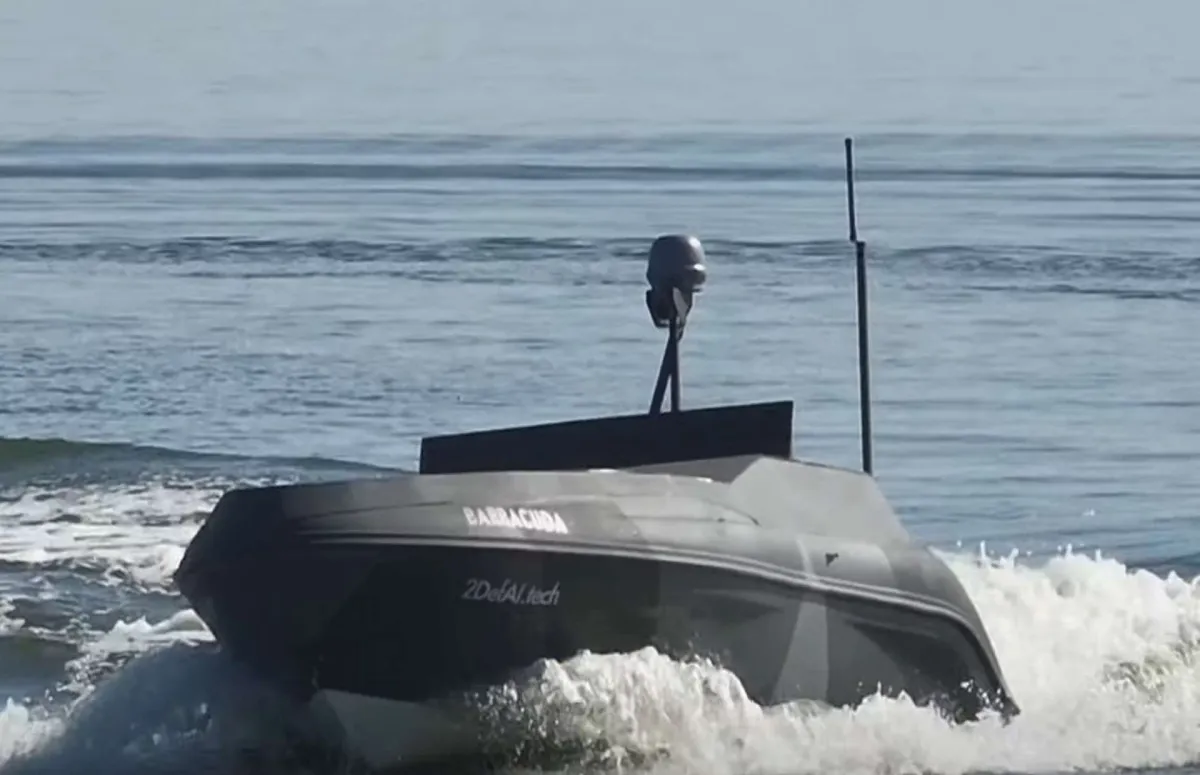
On October 20, 2025, the Ukrainian 40th Separate Coastal Defense Brigade showcased a successful operation using its Barracuda unmanned surface vessel to launch FPV drones against a Russian transport ship in the Dnipro delta.

Key facts
- Ukrainian Barracuda unmanned boat launched FPV drones against a Russian vessel.
- Operation minimized risk to Ukrainian personnel while destroying enemy assets.
- The tactic enhances operational range and reduces reaction time in maritime conflicts.
2 minute read
The Barracuda USV acting as a forward launcher for FPV drones signals a shift in littoral warfare. By staging low cost munitions close to target, Ukraine extends range, shortens the kill chain, and reduces exposure. The concept exploits rivers and deltas where line of sight control is hard and electronic warfare is dense, turning the USV into a mobile magazine and relay that complicates Russian force protection around transport nodes.
For Europe and NATO navies, this validates distributed, attritable maritime operations. Coastal defense, riverine security, and logistics protection now require layered counter UAS and counter USV measures around ports, bridges, and ferries, not only blue water assets. Baltic archipelagos, the Black Sea coast, and the Danube corridor are vulnerable to similar tactics. Patrol craft need organic jammers, radar and electro optical pickets, and expendable drone escorts.
The approach is economically asymmetric. Commercial components, modular payload bays, and basic navigation enable rapid fielding at scale. European planners should prioritize secure command links, GNSS denied navigation, mesh networking, and common interfaces so varied drones can be ferried from shared platforms. European Defence Fund support and NATO standardization can speed spiral upgrades while keeping unit costs low, backed by pooled procurement for munitions and spares.
Russia will adapt with stronger jamming, decoys, nets, and tighter convoy discipline. Expect resilient autonomy, optical guidance, and saturation tactics in response. Civil shipping in inland waterways faces spillover risk, elevating the need for maritime domain awareness, deconfliction tools, and clear rules of engagement. Europe’s defense model is moving toward cheap, networked autonomy that will define the next phase of warfare.
You might also like to read…
 Mr. T (Curator)
 Mr. T (Curator)
 Mr. T (Curator)