
US Army reform push stalls as Secretary Driscoll resigns amid Pentagon infighting
Dan Driscoll resigned as U.S. Army secretary amid reported clashes over AI-, drone- and counter-UAS-focused transformation and the removal of aligned generals—raising questions for Europe about continuity in US modernisation priorities and Army Europe leadership.

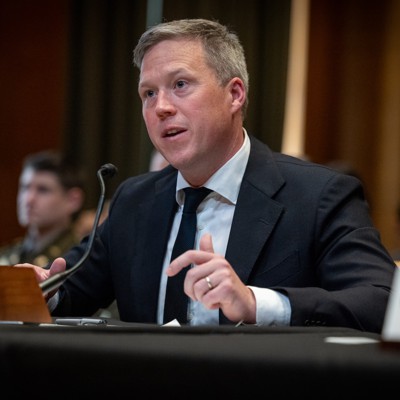
Key facts
- Dan Driscoll resigned as U.S. Army secretary; a source cited Hegseth’s removal of generals tied to Driscoll’s transformation agenda as the primary cause.
- Driscoll’s May 2025 Army Transformation Initiative focused on AI-enabled decision support, decentralised acquisition/modification authority, modernised drone formations, and closing counter-drone gaps.
- After Gen. Randy George’s ouster, acting chief Gen. Christopher LaNeve ordered a battalion working with Ukrainians on drone-warfare lessons to return to a traditional infantry role (per AP link cited in the source text).
3 minute read
Dan Driscoll, appointed as U.S. Army secretary and publicly framed by Donald Trump as a “disruptor and change agent,” has resigned, in a move first reported by the Wall Street Journal and confirmed by a source directly familiar with the matter. That source attributed the resignation primarily to Defense Secretary Pete Hegseth’s removal of generals associated with Driscoll’s innovation and transformation efforts, characterising the firings as effectively blocking Army transformation and readiness initiatives.
Driscoll’s tenure was defined by an explicit push to compress the Army’s innovation cycle around lessons drawn from Ukraine’s wartime adaptation, including “MacGyvered” field solutions and rapid iteration under combat pressure. In May 2025 he launched the Army Transformation Initiative, whose key elements—per the source text—were integrating artificial intelligence into decision-making, pushing purchasing and modification authority down the chain of command, deploying modernised drone formations, and addressing a stated “gap” in counter-drone technology. His public messaging stressed urgency and a software-centric approach to battlefield advantage, arguing the Army should “win with silicon and software” rather than attrition of personnel.
The internal conflict described in the source appears to have centred on senior-leader alignment. The article states that Driscoll worked closely with a group of uniformed leaders including Gen. Randy George, Gen. David Hodne, Gen. James Mingus and Gen. Christopher Donahue—figures it says Hegseth has pushed out or removed. The cited sequence matters operationally: the text notes that after the ouster of George, acting chief Gen. Christopher LaNeve ordered a battalion engaged with Ukrainians on integrating drone-warfare lessons to revert to a traditional infantry role, a decision that—if accurately characterised—would indicate a pullback from institutionalising Ukraine-derived UAS tactics inside the U.S. Army.
For Europe, the immediate implication is not personnel drama per se but uncertainty over the durability of U.S. Army modernisation threads most relevant to the current European threat picture: scalable drone formations, counter-UAS at tempo, and delegated authorities enabling fast procurement and modification. European procurement officers and industry should anticipate potential oscillation in U.S. demand signals and doctrinal emphasis, even as the Ukraine war continues to validate high-volume attritable UAS and layered counter-UAS. The removal of the U.S. Army Europe and Africa commander cited in the text also suggests potential discontinuity in how quickly operational lessons, requirements, and interoperability priorities are translated across the Atlantic.
Source: Defense One


