US ‘Clear Horizon’ drill drives shift to networked counter-drone defense
A Ukraine-modeled drone raid exercise pushed the Pentagon toward shared drone tracking, sensor-to-effector integration, and cheaper interceptors—lessons Europe can operationalise for NATO base defence.

Key facts
- Operation Clear Horizon at Eglin AFB replicated Ukraine-like drone tactics, using Group 1–3 UAVs and jamming-resistant control methods.
- The exercise included fibre-optic controlled drones and LTE-controlled drones, with operators in Colorado reportedly able to launch effects in Florida.
- JIATF-401 says the US has moved to a single drone-tracking software/interface across services and has committed over $600m in recent weeks for rapid C-UAS tech integration.
3 minute read
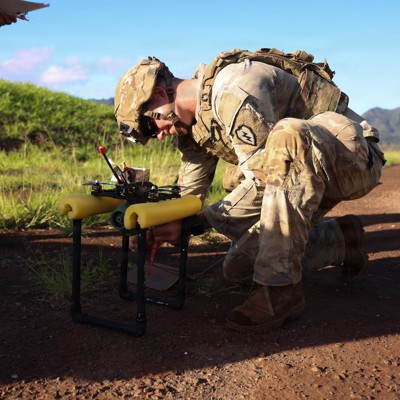
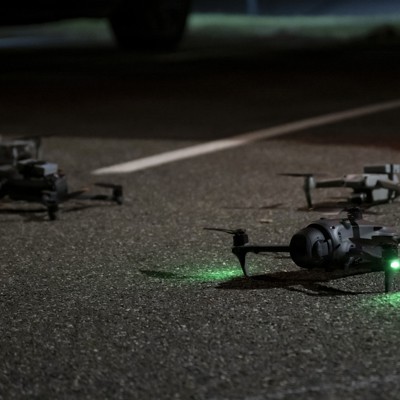
Operation Clear Horizon at Eglin Air Force Base was designed to reproduce battlefield conditions observed in Ukraine rather than the more sanitised counter-UAS trials typical of US test culture. According to Brig. Gen. Matt Ross, head of Joint Interagency Task Force 401 (JIATF-401), the attacking element (10th Special Forces Group) flew a mix of commercial RF drones and more resilient variants with directional antennas and frequency hopping, spanning Group 1 through Group 3 classes. The exercise also introduced control pathways that complicate traditional countermeasures: fibre-optic controlled drones (less vulnerable to RF jamming) and drones controlled over LTE, enabling remote operators in Colorado to launch effects against targets in Florida. The overall construct mirrored Ukraine’s “spiderweb” approach of coordinated, multi-vector drone pressure on high-value assets.
The drill reinforced structural limitations on US counter-drone testing. Electromagnetic effects used to defeat drones can disrupt aircraft guidance and civilian cellular service, restricting where and how EW-based defences can be exercised. As a result, many events focus on non-missile kill chains without fully replicating jamming-resistant systems or low-observable flight profiles. Ross also highlighted a data problem: dozens of counter-UAS tests across services and commands generate results that are not readily comparable or centrally visible, limiting rapid learning cycles against a threat that evolves faster than annual budget rhythms.
JIATF-401’s response, as described in the source, is both technical and acquisitional. The September event demonstrated the need for cross-installation track sharing and a unified interface so that drone tracks can be handed off between sites and that “any sensor” can be paired with “any effector.” Ross stated that the US now has a single drone-tracking software solution and interface across the services (details not provided). The task force is also using performance data observed in Ukraine to inform US choices rather than relying solely on internal testing. Procurement priorities are shifting toward defending against longer-range drones capable of striking command-and-control, logistics and air-defence nodes, while developing lower-cost interceptor drones for Groups 1–2 to avoid using expensive missile inventories for attritable targets.
For Europe, the message is operationally immediate. US emphasis on shared air-domain awareness tooling and sensor-to-effector interoperability aligns with NATO’s persistent challenge of integrating multi-national C-UAS assets around dispersed bases and critical infrastructure. The prominence of fibre-optic and cellular-control modalities underscores that European procurement and regulatory frameworks must plan for countermeasures beyond RF jamming, including kinetic and interceptor-UAV concepts, and for realistic training that accounts for electromagnetic deconfliction with civil aviation and telecoms—an acute constraint in densely populated European operating environments.
Source: Defense One