VolleyBots: Advancing Multi-Drone Sports with AI and Strategy
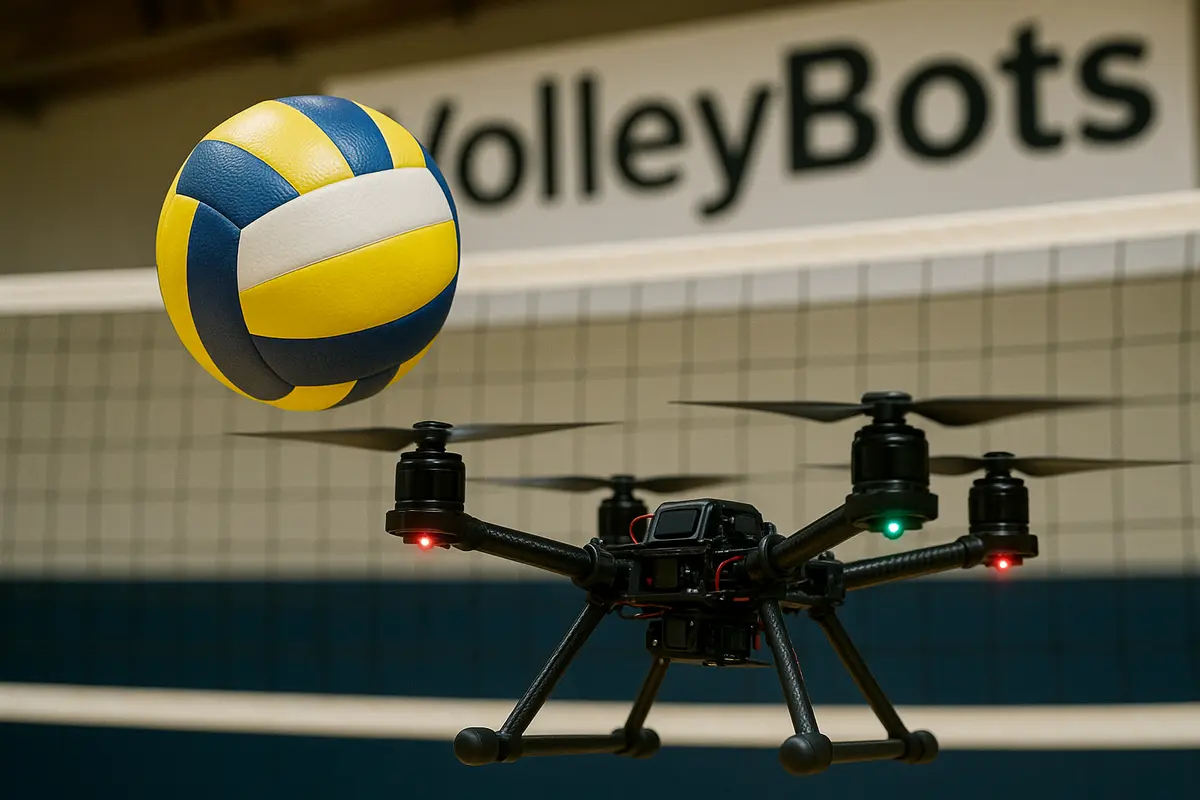
The VolleyBots project introduces a multi-drone volleyball testbed that merges motion control with strategic gameplay. This innovative platform showcases the potential of drones in cooperative and competitive environments, providing insights into reinforcement learning and real-world applications.

Key facts
- VolleyBots integrates competitive and cooperative drone gameplay in volleyball.
- A hierarchical policy achieved a 69.5% win rate in complex multi-drone tasks.
- Zero-shot deployment demonstrates the real-world applicability of simulation-trained policies.
2 minute read
VolleyBots is more than a novelty. It is a disciplined environment to test how autonomous drones coordinate, plan and execute under real dynamics. For Europe and NATO, this type of embodied intelligence matters because swarms that can sense, decide and act with minimal human input will shape air defence, logistics and counter-UAS operations.
The algorithmic takeaway is pragmatic. On-policy methods excel for single platforms, but complex team manoeuvres strain today’s reinforcement learning. The reported 69.5 percent win rate from a hierarchical policy in 3 vs 3 play suggests a viable architecture, higher level strategy guiding lower level control, that maps onto NATO concepts for modular autonomy and human on the loop command.
Policy and standards should move in lockstep. Testbeds like VolleyBots can stress resilience to latency, sensor loss and interference, conditions common in European theatres with dense spectrum use and contested GNSS. Results can inform U-space integration, SORA risk assessments and spectrum management so autonomous teams operate safely alongside civil traffic.
Capability development is equally clear. Sim to real success points to faster iteration cycles, letting EU labs and NATO DIANA sites validate tactics, techniques and procedures before field trials. This lowers cost for swarm tactics, base defense drills and maritime ISR, and builds sovereign know how in autonomy stacks, compute efficiency and dataset generation.
Governance must anticipate misuse and failure modes. Shared metrics, reproducible evaluations and red teaming against countermeasures will be essential to avoid brittle policies overfitted to simulation. Europe should channel such testbeds into operational experimentation at scale to keep pace as warfare becomes software defined and swarming.