
Pentagon S&T Chief: Mass Drones, AI Control, and Field-Made Munitions
Pentagon S&T leadership is pushing a Ukraine-derived model: fast fielding, attritable mass (AI-enabled drones), and even containerised, local-material production of munitions—raising competitive and governance implications for Europe.

Key facts
- Jewell says Ukraine has fielded relevant capabilities during the war that did not exist at its outset, demonstrating a new innovation tempo.
- He argues future effects will combine high-end systems with massed drones—hundreds or thousands—progressing from manual FPV control toward AI-enabled control.
- DoD’s no-fee patent licensing programme covers ~500 patents; Jewell reports 14 signed out, 1 exclusive paid licence, 36 pending, and 145 additional applications as of mid-June.
3 minute read
Speaking at the Defense One Tech Summit, Joseph Jewell, the Pentagon’s assistant defense secretary for science and technology, framed Ukraine as a proof case for a faster innovation-to-battlefield cycle: capabilities that “didn't exist at the beginning of the fight” have been brought into combat relevance during the war itself. His core claim is that urgency and permissive adaptation pathways—not only laboratory breakthroughs—are now decisive, and that the United States must learn to replicate Ukraine’s rapid fielding and scaling dynamics with its larger industrial resources.
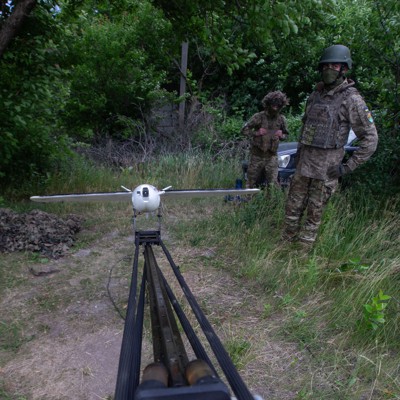
Jewell pointed to Ukraine’s ability to take the Russian Navy “out of the fight” in the Black Sea without possessing a traditional fleet, attributing the effect to small, relatively undetectable weapon systems fielded in large quantities. He argued that while high-end, expensive systems still matter, they will increasingly be complemented by massed drones, potentially “a hundred or a thousand” platforms, with autonomy and AI-enabled control replacing today’s human-in-the-loop FPV model as the “natural evolution.” The implication for Europe is direct: a force posture built around limited numbers of exquisite platforms risks being tactically outpaced unless procurement and sustainment pipelines can support attritable mass, rapid iteration, and resilient C2 under jamming and air defence pressure.
On industrial acceleration, Jewell described a Defence Department “patent holiday” announced by Undersecretary Emil Michael in January, allowing private firms to license a subset of DoD-held patents—about 500 cited—at no fee. He said the first no-fee licence was granted the prior month; by mid-June, 14 patents had been signed out for commercial use, one licensed for a fee for exclusivity, 36 applications were pending, and 145 additional applications had been submitted. For European primes and dual-use SMEs, the initiative signals a more aggressive U.S. posture on lowering barriers to adoption of government-owned IP; it also increases competitive pressure on European defence innovation frameworks to shorten contracting cycles and clarify IP terms for rapid production partnerships.
Jewell also tied biotech and AI to operational advantages, citing a bioengineered thermal coating intended to help drones reduce heat signatures, developed via BioMADE, a DoD-sponsored Manufacturing Innovation Institute. He further described Marine experiments producing 3D-printed shaped charges using locally available inputs including plastic bottles, crushed volcanic rock, coconut husks and coffee grounds; he claimed all detonated, with volcanic rock most effective, and stated the resulting shaped charge had “25% better focusing characteristics” than conventionally manufactured high explosives. He envisaged containerised, deployable production—CONEX-box-scale facilities—supporting point-of-use manufacture of energetic components and potentially fuels. For Europe, the takeaway is the growing military value of distributed manufacturing and local-material supply chains in contested logistics, alongside the regulatory, safety and export-control challenges such methods would create within EU and NATO frameworks.
Source: Defense One


