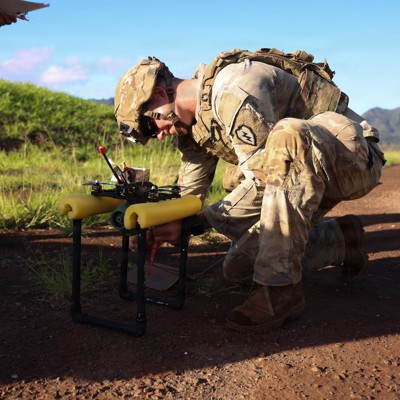
Dutch MoD to embed drones and counter-UAS across all combat units
The Netherlands plans to embed drones and counter-UAS across all combat formations, signalling a NATO-leading shift toward unit-level unmanned warfare readiness.


Key facts
- Dutch Chief of Defence Gen Onno Eichelsheim announced plans to structurally integrate drones and counter-drone capabilities across all combat formations (TV interview, March 22).
- The Netherlands aims to be the first NATO member to implement this integration across all combat units, according to the report excerpt.
- The initiative includes recruiting more than 1,000 drone operators, indicating a large-scale personnel and training effort.
3 minute read
The Dutch armed forces intend to structurally embed drone and counter-drone capabilities across all combat formations, a move presented by Chief of Defence General Onno Eichelsheim as a response to the realities of modern drone warfare. If implemented as described, this would represent a doctrinal and organisational pivot: unmanned systems would no longer be treated as niche enablers held in separate specialist units but as routine, organic capabilities held at the level where manoeuvre, fires, and protection converge.
Although the available source material is limited, the operational logic is clear. Ubiquitous small UAS have become central to tactical ISR, rapid target acquisition, battle-damage assessment, and the conduct of attritional “sensor-to-shooter” loops. Conversely, the proliferation of low-cost drones forces ground units to field equally ubiquitous counter-UAS measures, spanning detection, identification, and defeat, to protect formations, logistics nodes, and command posts. Embedding both functions across combat formations implies continuous training, standard operating procedures, and command-and-control integration rather than episodic deployment.
For European defence officials and industry, the Dutch announcement has immediate implications. A requirement reportedly exceeding 1,000 operators suggests a sizeable training and retention challenge and, by extension, demand for simulators, certification frameworks, and sustainment ecosystems. It also signals likely pull-through for interoperable cUAS sensors and effectors that can be fielded at scale and integrated into NATO communications and airspace management. If the Netherlands does become the first NATO member to formalise this across all combat units, it may catalyse similar force-design decisions elsewhere in Europe, accelerating standardisation pressures on platforms, datalinks, electronic protection, and rules of engagement for kinetic and non-kinetic drone defeat in national and allied contexts.
Source: dronewatch.eu