Ejection-seat firms pivot toward unmanned systems at Farnborough
At Farnborough 2026, Martin-Baker and Collins signalled how crewed-aircraft safety suppliers are repositioning for CCAs and wider unmanned airpower.
Key facts
- Martin-Baker says it is offering electronics and manufacturing expertise to drone makers, including potential support for launch concepts and “payload destruction”.
- Collins Aerospace states its ACES ejection seats have saved more than 730 lives since 1978 and remain focused on pilot protection for crewed fleets.
- RTX is simultaneously advancing unmanned capabilities: Collins’ Sidekick autonomy was down-selected for CCA production, Pratt & Whitney is progressing the Valox 1500 CCA engine, and Raytheon is integrating AMRAAM onto CCA.
3 minute read
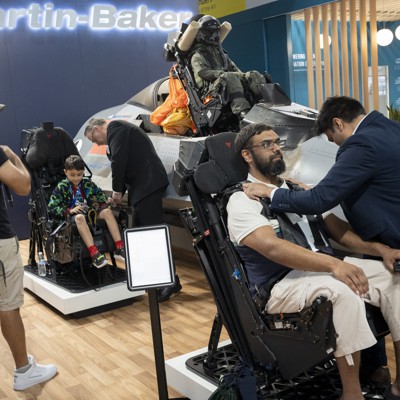
The Farnborough International Airshow offered an unusually clear snapshot of how niche but strategically embedded aerospace suppliers are adapting to the rapid shift toward unmanned and optionally manned combat aviation. Martin-Baker—an emblematic European defence industrial actor whose ejection seats have saved more than 7,800 aviators—publicly framed its future not as a retreat from crewed aviation but as a deliberate expansion into enabling technologies for drones and autonomous aircraft. The company’s business development lead, Steve Roberts, described outreach to both small and large unmanned manufacturers, proposing support that spans electronics capabilities, launch-related engineering, and “payload destruction” concepts—an implicit reference to controlled denial, anti-tamper, or safe-termination functions that become more salient as autonomy proliferates and aircraft are expected to operate over contested territory or risk capture.
The reporting also underlines that ejection-seat demand will not collapse quickly. The article notes ongoing investment and attention in high-end fighter programmes including GCAP and US next-generation projects, suggesting a prolonged mixed fleet in which manned platforms remain central while uncrewed adjuncts scale. This matters for European procurement planning: budgets will continue to carry parallel cost lines for exquisite crewed aircraft survivability systems alongside rapidly iterating unmanned subsystems. The implied industrial opportunity is that suppliers like Martin-Baker can leverage certification discipline, manufacturing quality, and safety engineering into uncrewed programmes where reliability and lifecycle assurance are becoming procurement differentiators rather than afterthoughts.
RTX’s Collins Aerospace illustrates the dual-track reality. Collins reiterated its core mission around pilot protection—its ACES ejection seat family has reportedly saved more than 730 lives since 1978—while RTX simultaneously pushes deep into the CCA stack. The article cites Collins’ Sidekick autonomy software being down-selected for CCA production, Pratt & Whitney reaching a design milestone on a dedicated CCA engine (Valox 1500), and Raytheon integrating AMRAAM onto CCA. For Europe, the implication is competitive and structural: US primes are converging autonomy, propulsion, and weapons integration into integrated offerings for scalable “manned-unmanned teaming.” European aerospace executives and officials should read this as pressure to accelerate indigenous autonomy toolchains, weapon-integration pathways, and common architectures—while also recognising that specialised European safety suppliers may find new relevance as providers of mission assurance, secure termination, and trusted manufacturing in both high-end “expensive unmanned” and attritable low-cost segments.
Source: Defense One