Firestorm prints parts at Sea State 5, validating shipboard expeditionary 3D manufacturing
Firestorm says it printed thousands of parts and FPV drones aboard USS Essex in Sea State 5, signalling shipboard additive manufacturing as a contested-logistics enabler relevant to Europe’s forward sustainment planning.

Key facts
- Firestorm Labs reported printing “thousands” of unique parts aboard USS Essex while transiting to RIMPAC in Sea State 5 conditions.
- The company used its xCell expeditionary additive manufacturing unit (two 20-foot containers) and an HP multi-jet fusion 3D printing arrangement.
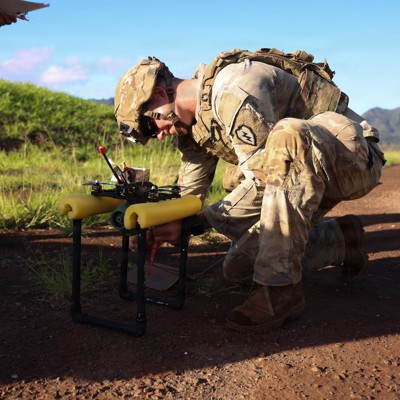
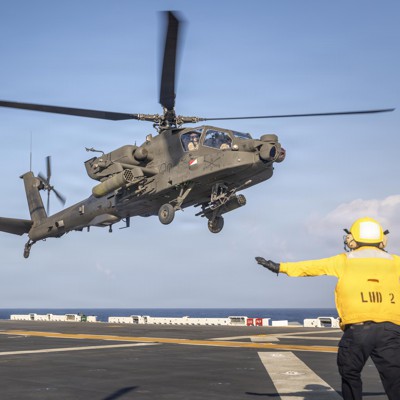
- Items printed at sea included Apache rotor-protection stops and a dozen Squall FPV drones later used as adversary aircraft in a counter-drone exercise.
3 minute read
Firestorm Labs has used a transit to the Rim of the Pacific (RIMPAC) exercise to showcase what it frames as “expeditionary manufacturing” at sea, reporting that it printed “thousands” of unique parts aboard the USS Essex amphibious assault ship while operating in Sea State 5 conditions. The company’s leadership argues the demonstration supports a contested-logistics thesis: additive manufacturing can compress repair cycles and reduce dependency on vulnerable supply routes when platforms are dispersed, resupply windows are narrow, and shipment lead times become operationally unacceptable.
The capability centres on Firestorm’s xCell unit, described as two 20-foot container modules intended to deploy “anywhere”, paired with an exclusive arrangement with HP using multi-jet fusion 3D printing. Firestorm representatives emphasised machine resilience under heavy ship motion and pitched the system as applicable across a broad set of use cases, ranging from sustainment of legacy systems with degraded supply bases to production of “attritable” systems such as drones closer to the point of employment.
Specific items shown during a tour included printed stops designed to prevent Apache helicopter rotor blades from scraping the ship’s non-skid deck coating. Firestorm’s field operations manager also said the team printed a dozen Squall first-person-view drones while underway; these were later used as adversary aircraft during a counter-drone exercise associated with RIMPAC. The company highlighted nylon composite material as suitable for diverse outputs, including humanitarian assistance and disaster relief items, reflecting a narrative of broad-spectrum utility rather than narrow platform-specific spares.
For European defence planners, the episode is a practical data point—albeit vendor-reported—on whether containerised additive manufacturing can function on moving naval platforms in rough seas, a non-trivial constraint for shipboard deployment in the North Atlantic or Baltic. If reproducible at scale, such systems could mitigate sustainment risk for forward-deployed NATO forces and reduce dependence on transcontinental supply chains in crisis scenarios. It also underscores a growing convergence between logistics resilience and drone mass/attrition requirements, where the ability to iterate and replace rapidly may become as decisive as the baseline performance of any single unmanned platform.
Source: Defense One