France rewrites its airpower and drone playbook ahead of a possible Russia test
France is updating procurement to counter cheap Shahed-type drones, expand munitions stocks and bolster air superiority enablers amid warnings Russia could test NATO in 2028–2029.


Key facts
- France will present an updated military planning law on April 8, incorporating lessons from Ukraine and the Middle East.
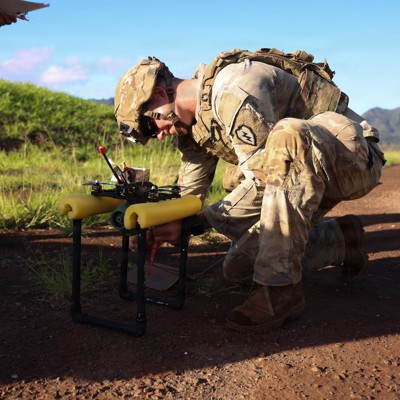
- French forces are pursuing cheaper counter-Shahed options (Fennec helicopter engagements, lower-cost laser-guided rockets on Rafale) and developing interceptor drones with Alta Ares and Harmattan AI.
- French Air and Space Force leadership warns Russia could test NATO in 2028–2029, implying Western European air forces would be on the eastern flank from day one.
3 minute read
France is recalibrating its procurement and operational planning around two converging data sets: the industrial-scale attrition and drone saturation seen in Ukraine, and the air-and-missile fight around Iran and the Gulf in which French assets have been deployed. With an updated military planning law due on April 8, Gen. Dominique Tardif, deputy chief of the French Air and Space Force, frames the shift as a practical effort to extract capability-development lessons “from Ukraine… [and] what is currently happening in the Middle East,” with an explicit eye on the eastern flank and a potential confrontation with Russia later this decade.
At the tactical level, Paris is targeting the cost-exchange imbalance exposed by mass-produced Shahed-type drones, used by Russia in Ukraine and by Iran in the region. Tardif says the Air and Space Force is pursuing cheaper ways to defeat such threats, including engaging drones from Fennec helicopters and integrating lower-cost laser-guided rockets on Rafale fighters. France is also working with Alta Ares and Harmattan AI on interceptor-drone concepts; while not fully operational, Alta Ares’ programme is described as ramping up, with equipment already deployed on the ground in the Middle East. The effort is reinforced by Defence Minister Sébastien Lecornu’s statement that French firms could produce thousands of interceptor drones per month and by a planned €8.5 billion munitions spend by 2030, reflecting a broader pivot from small stockpiles toward sustained production capacity and duplicated lines.
Strategically, the French assessment underscores air superiority as the hinge between a war of attrition and a war of decision. Tardif contrasts Russia’s inability to secure air superiority in Ukraine with U.S.-Israeli operations against Iran, arguing that the latter demonstrates anti-access/area-denial is not inevitable if sufficient means are applied, including suppression of enemy air defences. France is therefore examining dedicated SEAD/DEAD enablers, with MBDA’s “Stratus” programme cited as incorporating such effects.
For Europe, the most consequential element is the timeline. Tardif echoes French senior warnings that Russia could “test NATO” in 2028–2029. He argues that limited fighter aviation in the Baltic states and constrained capacity in Romania would pull Western European air forces to the front line immediately, making French readiness, deployability, base defence and munitions depth salient collective requirements. In parallel, Paris is studying cheaper methods to protect air bases, explicitly referencing Ukraine’s deep strikes against Russian airfields. Yet the French approach rejects a purely low-cost posture: mass for saturation is required, but so are “decisive munitions” to avoid a frozen conflict dynamic.
Finally, France is moving toward collaborative combat aircraft—AI-enabled uncrewed platforms in the two-to-four-ton class designed to operate alongside manned fighters—primarily to improve detection and geolocation of threats. A request for information via the DGA is planned to survey industrial offerings, with platforms such as Anduril’s Fury and the Airbus–Kratos Valkyrie cited as market references. Tardif also signals an expectation of rapid Russian adaptation in drones, missiles and sensors, driven by Moscow’s resource allocation to defence industrial capacity—an implicit warning that Europe’s counter-UAS and airpower modernisation windows are narrowing.
Source: POLITICO Europe