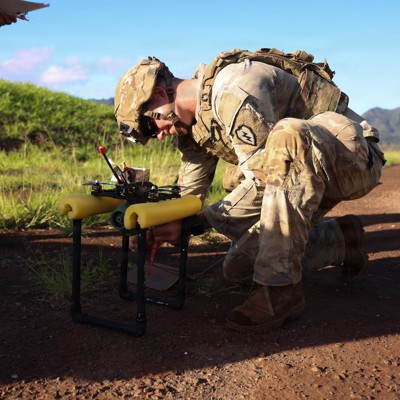
France’s top general warns: cheap drone swarms can outpace defenses
France’s CHOD warns low-cost drone saturation can outpace French/NATO defensive stockpiles and make current cost-per-kill economics untenable.


Key facts
- France’s CHOD Gen. Fabien Mandon said France is not yet ready to face cheap, mass-produced drone threats.
- Mandon warned adversaries are fielding large volumes of low-cost systems intended to wear down Western force models and budgets.
- He said French defensive weapons are not produced in sufficient quantities to stop saturation waves and is pushing faster adoption of drones.
3 minute read
Gen. Fabien Mandon’s warning that France is “not yet ready” to face cheap, mass-produced drone threats is best read as a candid admission that the air-defence and force-protection problem has shifted from exquisite capability to sustainable volume. The operational pattern seen since 2022—large numbers of low-cost one-way attack drones and other unmanned systems used to probe and saturate defences—puts pressure on NATO’s traditional reliance on high-end interceptors and limited inventories. Mandon’s emphasis on adversaries developing “a large number of low-cost solutions” highlights the strategic intent: attrit not only platforms and infrastructure, but Western budgets, magazines, and industrial capacity.
For European procurement, the key metric Mandon referenced—reducing cost per kill—has become a defining requirement. When multi-million-euro missiles are used to defeat targets costing tens of thousands, the defender can be tactically successful yet strategically exposed through depletion and unaffordable tempo. Politico notes a recent French Air Force case in the Gulf where costly missiles were used against cheap Iranian drones, underscoring that this is not a Ukraine-only issue but a recurring operational reality for European forces deployed abroad and at home.
Mandon’s additional point that French defensive weapons are not produced in sufficient quantities to stop “waves of saturation” directly implicates industrial scaling and procurement lead times, not merely tactics or doctrine. His stated intent to accelerate French armed forces’ use of drones suggests France is pursuing symmetry in mass and price—fielding more unmanned systems for reconnaissance, strike, and possibly counter-UAS roles—while industry (MBDA and startups such as Alta Ares and Harmattan AI) develops cheaper, mass-producible defensive options.
For Europe, the implication is that counter-UAS is becoming a theatre-wide, peacetime readiness issue as much as an expeditionary one. The challenge is to build layered defences with sufficient depth—combining cheaper effectors, electronic warfare, sensors, and scalable production—so that saturation attacks cannot be turned into an economic weapon against European militaries.
Source: Politico Europe