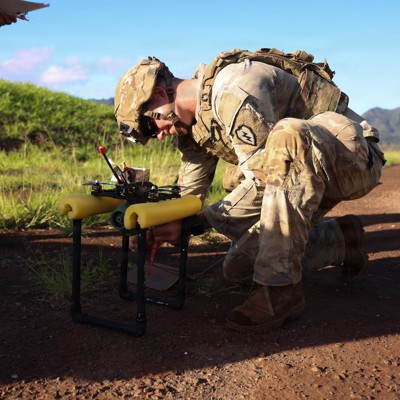
London Waterloo trials dock-launched drone for rail incident response
Network Rail Wessex and SWR are using a trackside drone dock at London Waterloo to stream live visual/thermal imagery for faster response to trespass and infrastructure incidents.


Key facts
- A remotely operated drone is being used at London Waterloo to respond to trespassing, infrastructure problems and other incidents.
- The system launches from a trackside docking station and is controlled remotely from a facility near Southampton.
- Railway control teams receive live visual and thermal information, reducing the need to send staff onto the tracks.
3 minute read
A remotely operated drone system has been introduced at London Waterloo to support incident response for South Western Railway (SWR) and Network Rail Wessex, with the declared focus on trespass events, infrastructure problems and wider disruption. According to the source, the aircraft can be launched from a trackside docking station and piloted remotely from a facility near Southampton, allowing control teams to obtain real-time visual and thermal imagery without dispatching personnel onto the tracks.
Although the available details are limited, the operational concept is significant for European transport security and infrastructure protection. A docked, on-demand drone effectively turns the station environment into a semi-persistent sensor node, potentially compressing the time from incident report to verified situational picture. In rail contexts, that can reduce the number and duration of track incursions by staff, which is both a safety improvement and a lever for operational continuity during disruptions.
For European decision-makers, the implied procurement and governance questions are immediate: how remote operations are authorised in complex urban airspace, what operational limitations are imposed by safety cases near overhead lines and crowded station approaches, and how data handling is managed when thermal imagery is used in a public transport setting. The reliance on a control facility geographically separated from the dock also elevates the importance of resilient communications, cybersecurity assurance and clear command-and-control procedures to prevent loss-of-link events or unauthorised tasking. Even as a civil deployment, the model is relevant to broader critical infrastructure surveillance—ports, energy sites and logistics hubs—where docked UAS can provide rapid verification before committing ground teams.
Source: DroneWatch.eu