MQ-28 Ghost Bat flies Valiant Shield, sharpening CCA prospects for Europe
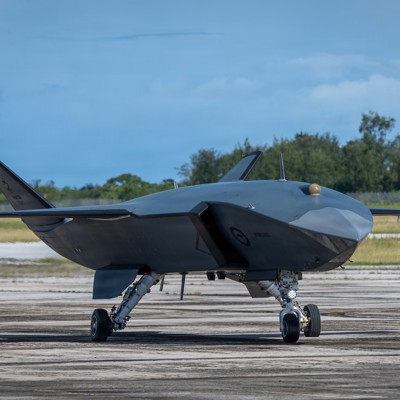
Boeing’s MQ-28 Ghost Bat flew in Valiant Shield with US and allied aircraft, boosting its coalition CCA credentials as Germany eyes operational wingmen by 2029.

Key facts
- Boeing’s MQ-28 Ghost Bat flew in the multinational Valiant Shield exercise in the Northern Mariana Islands alongside US and allied aircraft.
- USAF’s first CCA production awards went to Anduril and General Atomics; Boeing was previously dropped from Increment 1 and did not enter MQ-28 into that competition.
- Germany is considering MQ-28 for a 2029 “drone wingman” target, with an industry team including Rheinmetall, Diehl Defence, Rohde & Schwarz, and HENSOLDT.
3 minute read
Boeing’s MQ-28 Ghost Bat has achieved a politically and operationally salient benchmark by flying in Valiant Shield, a large multinational exercise staged in the Pacific’s Northern Mariana Islands, alongside US and allied forces. According to Boeing Defense Australia’s MQ-28 global programs director Glen Ferguson, the sortie series represented an early, practical step in integrating collaborative combat aircraft into coalition air operations, with future opportunities likely to come through major multinational drills rather than single-nation events. He explicitly pointed to Australia’s Talisman Sabre next year as the kind of venue where the Royal Australian Air Force could apply these systems as operational capabilities and iterate tactics.
The event matters because it places Boeing’s CCA narrative on a different track from the US Air Force’s near-term procurement choices. The USAF excluded Boeing from its first CCA increment two years ago and awarded initial-production contracts in June to Anduril and General Atomics; Boeing did not offer MQ-28 into that first competition. While the service has since funded work toward a second CCA iteration, it is not publicly known whether Boeing is participating, and Ferguson declined to comment. In effect, MQ-28’s value proposition is being advanced through demonstrable coalition integration and exercise credibility rather than through the first tranche of USAF production awards.
Boeing and US officials used the Valiant Shield appearance to signal deterrence-relevant capability maturation in the Indo-Pacific. Ferguson said US government feedback was positive and noted Indo-Pacific Command’s Adm. Sam Paparo was pleased to have a CCA present in theatre. A USAF release framed the activity as advancing human–machine teaming to increase power projection and resilience, while Boeing stated the MQ-28 flew alongside a broad set of crewed platforms including F-35s and F-15EX, as well as key enablers such as E-3 and E-2D.
For Europe, the implication is immediate for Germany’s emerging loyal wingman market. The Bundeswehr plans to field operational drone wingmen by 2029, aligning with stated US ambitions to field 100 operational CCAs by 2029. Boeing’s German MQ-28 bid has gained industrial mass through Rheinmetall plus electronics and mission-system partners including Diehl Defence, Rohde & Schwarz, and now HENSOLDT. The MQ-28’s multinational-exercise exposure offers a concrete data point for European procurement stakeholders focused on interoperability, tactics development, and coalition certification pathways—areas likely to weigh heavily alongside platform performance and sovereign mission-system integration.
Source: Defense One