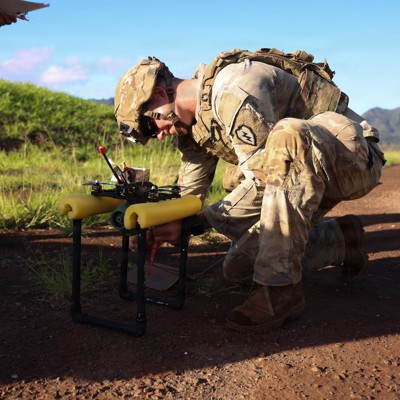
NATO accelerates digital transformation toward multi-domain unmanned ecosystems
NATO says Ukraine has forced a shift to rapid experimentation, commercial standards adoption, and multi-domain unmanned “system-of-systems” interoperability.


Key facts
- NATO transformation leadership says the alliance has shifted since 2022 toward faster experimentation and interoperability over long platform-centric cycles.
- Ukraine’s lesson is framed as an integrated, multi-domain robotic ecosystem (UGV/UAV/USV/UUV) where orchestration and mass matter more than any single drone.
- NATO is pushing more frequent counter-UAS experimentation (every 2–3 months) and faster standards by adopting commercial/international standards rather than adapting them.
3 minute read
NATO’s senior transformation leadership is characterising the past three to four years as a structural break in how the alliance modernises and fights, driven by the realities of Russia’s war against Ukraine. Maj. Gen. Dominique Luzeaux, NATO’s digital transformation champion and special advisor to the Supreme Allied Commander Transformation, argues the centre of gravity is moving from long-cycle, platform-led acquisition toward rapid experimentation, interoperability and “system-of-systems” design, with the operational benchmark set by Ukraine’s accelerating use of unmanned ground, air, surface and undersea systems.
The core operational takeaway, in Luzeaux’s framing, is that effectiveness comes from an integrated, multi-domain robotic ecosystem: large numbers of heterogeneous unmanned systems, correctly composed and orchestrated, rather than marginal gains from a single exquisite platform. This has direct implications for European force design, where many national programmes remain optimised for platform replacement timelines and national stovepipes; the emerging NATO preference is for architectures that can federate national contributions into coherent multinational kill chains.
Luzeaux depicts the conflict as an “innovation cycle against innovation cycle,” with Ukraine forced to broaden innovation beyond narrow tactical platform tweaks to span strategic, operational and tactical levels simultaneously—an adaptive model NATO is now attempting to institutionalise. Practically, he points to layered counter-UAS experimentation cycles running every two to three months, indicating an intent to treat counter-drone capability as a continuously tuned system rather than a one-off procurement.
Architecturally, the emphasis is on separating functions from platforms and exploiting dual-use technology, including concepts such as using 5G infrastructure not only for communications but also for sensing. For European procurement officers and aerospace executives, the signal is a growing premium on modular payloads, software-defined capability, open interfaces and certification pathways that allow rapid integration of civilian tech into military architectures.
Standards policy is presented as another inflection point: NATO is seeking to adopt commercial and international standards rather than adapt them through slow alliance processes, while still relying on exercises to standardise procedures for multinational operations. Luzeaux also cites a Baltic Sea initiative—started as an experiment and now used by several northern countries—employing uncrewed surface vehicles to patrol and detect activity linked to Russia’s shadow fleet, illustrating the alliance’s push to move pilots into operational use faster. For Europe, the direction of travel is clear: competitive advantage will accrue to states and firms that can deliver interoperable systems quickly, iterate in exercises, and plug into NATO’s “glue” layer that pairs, for example, a US drone, German C2 and a French sensor into a single operational construct.
Source: Defense One