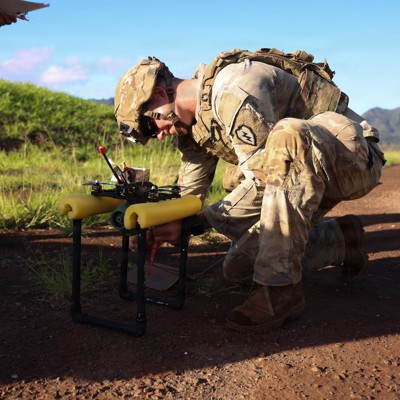
Pentagon launches AI c-UAS marketplace to accelerate allied buys
The Pentagon has funded Kaizen to build an AI-driven counter-UAS marketplace aimed at compressing FMS timelines and standardising interoperable c-UAS options for approved allies including Poland, Romania and the UK.

Key facts
- DoD counterdrone task force awarded Kaizen Laboratories $15m to build an AI-backed “two-way” counter-UAS marketplace; contract awarded 8 May via an other transaction agreement.
- Marketplace aims to be a single point of purchase for U.S. military users and approved allies/partners; also onboarding U.S. state and local agencies.
- Approved foreign users include Australia, Poland, Republic of Korea, Romania, and the United Kingdom; platform is positioned to accelerate FMS initiation and promote interoperable, networked air-defence commonality.
3 minute read
The Pentagon’s counterdrone task force has stood up a new AI-powered counter-UAS marketplace, funded through a $15 million award to Kaizen Laboratories, with an explicit objective of accelerating procurement and easing foreign military sales (FMS) execution for partner nations. The award was made on 8 May using an “other transaction agreement” rapid acquisition mechanism, and the platform has reportedly been operational for around two weeks prior to public disclosure. Kaizen describes the site as built “from a blank slate” to support the DoD’s FMS Fast Lane Initiative, positioning it as a two-way marketplace that simplifies both discovery and transaction initiation for approved foreign users.
Operationally, the marketplace is presented as a single point of purchase intended to improve interoperability outcomes by matching users to validated, compatible options. U.S. Army Undersecretary Mike Obadal linked the platform to the wider requirement for networked air defence—counter-UAS and ballistic-missile defence alike—arguing that allied forces must be able to “see the same picture” and, where feasible, converge on common information and equipment baselines. In practice, Obadal claimed the platform can translate an initial foreign enquiry into the start of formal FMS paperwork, compressing a process that traditionally takes “months at best” before a partner receives actionable feedback.
The list of currently approved foreign users—Australia, Poland, the Republic of Korea, Romania, and the United Kingdom—has direct European relevance. For Poland, Romania, and the UK in particular, the marketplace signals a U.S. attempt to standardise the c-UAS industrial menu and associated data backbone (hosted on Amazon Web Services) that partners will use to compare capabilities, availability, and pricing. If scaled, it could create procurement path dependence toward U.S.-screened options and data standards, potentially influencing European c-UAS competition dynamics and interoperability baselines across NATO formations and deployed coalitions.
Kaizen is signalling rapid iteration, including integration of test and compliance data, product discovery and comparison features, and logistics-oriented information such as repairability and right-to-repair catalogues. If those features materialise, the platform could become a de facto reference catalogue for what the U.S. considers deployable or interoperable c-UAS solutions—raising the stakes for European vendors seeking inclusion and for European ministries weighing whether to align national c-UAS acquisition pathways with U.S. digital FMS workflows or to prioritise sovereign/European procurement channels.
Source: Defense One