White House tech strategy boosts swarms—but narrows US military AI options
The White House tech strategy prioritises swarms and rapid acquisition, but its foundation-model bias and omission of open-weight AI could hinder deployable edge capability and advantage China—raising clear implications for European procurement and AI sovereignty.


Key facts
- The strategy prioritises drones, autonomy, and “multi-agent systems and swarm intelligence,” alongside undersea and space as key R&D and spending areas tied to Indo-Pacific deterrence.
- It pushes faster, non-traditional procurement (including OTAs and performance-based contracts) and seeks to broaden federal pathways for smaller defence tech firms.
- On AI, it elevates foundation models but omits open-weight/open-source approaches; critics argue this could hinder deployable edge AI and potentially benefit China.
3 minute read
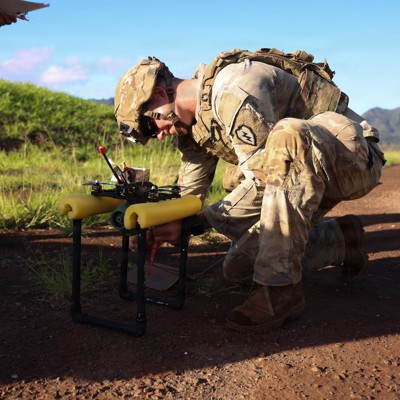
The White House’s new technology strategy (NSSTS, August 2026) is explicitly shaped by deterrence requirements in the Indo-Pacific and places drones—particularly quantity-driven, lower-cost and potentially attritable systems—at the centre of future force design. The document calls for “optimal combinations” of cheaper platforms deployed at scale to complement exquisite assets, and identifies undersea, space, and AI/autonomy as priority research and investment areas. Within that construct, “multi-agent systems and swarm intelligence” are treated as critical, signalling political top-cover for autonomy concepts that have struggled to transition from prototypes to programmes of record. The strategy also pushes the acquisition system toward faster, non-traditional pathways, including performance-based contracting and expanded use of OTAs, implicitly accepting higher programme risk in exchange for speed and operational relevance.
For the US industrial base, the strategy’s most consequential near-term impact may be market-shaping: it directs federal buyers beyond DoD to create streamlined entry routes for smaller firms, including CRADAs and other partnering constructs, and it targets export controls and foreign military sales rules that constrain young defence startups’ ability to sell to allies. If implemented, this could expand addressable demand for dual-use autonomy stacks, loitering munitions, and edge compute—areas where scale economics matter and where early exports are often decisive for survival. For Europe, the implication is twofold: US-origin autonomy suppliers may become more export-ready and price-competitive for NATO and EU customers, while European primes and startups will face a more aggressive US competitor set if barriers to allied sales are eased.
The strategy is more controversial on AI. While it champions defence innovation, it operationally privileges “foundation models” (large language, multimodal, and “world systems”) and does not mention open-weight models or open-source development. Critics argue this choice reinforces an energy- and compute-intensive AI development paradigm dominated by a small number of well-capitalised US labs and cloud providers, potentially narrowing experimentation with smaller, more deployable models. The omission also matters militarily: forward units often cannot rely on the connectivity and cloud backhaul that large-model approaches assume, and operational theatres such as Ukraine are already straining under hybrid architectures spanning cloud access, domestic data centres, and forward-deployed compute nodes.
Strategically, commentators cited in the source warn that sidelining open-weight approaches could advantage China, which has progressed in open-weight AI and thereby reduces the effectiveness of US strategies built around technology denial. For Europe, the lesson is immediate for procurement and sovereignty debates: forces prioritising resilient, edge-deployable AI for contested environments may need explicit requirements for open-weight/open architectures, exportable model governance, and local compute pathways—otherwise they risk inheriting a US-led ecosystem optimised for hyperscaler economics rather than tactical practicality.
Source: Defense One