XTEND’s $1.5bn Nasdaq route and fast-moving defence drone pipeline
XTEND’s $1.5bn Nasdaq bid, fresh SOF-linked delivery claims and a ParaZero counter-UAS tie-up warrant European scrutiny—alongside export-policy and political-risk factors.


Key facts
- XTEND is pursuing a $1.5bn merger with JFB Construction Holdings to list on Nasdaq as “XTND”, expected to close by mid-2026.
- The merger is backed by $152m in strategic investments including Eric Trump; Unusual Machines is also cited as a merger backer.
- XTEND announced completion of an $8.8m US government contract (US SOF deliveries/training) and an $8m Middle East contract expandable to $25m for 5,000 systems plus options for 10,000 more; it also announced a counter-UAS partnership with ParaZero’s net-capture DefendAir.
3 minute read
XTEND, an Israeli-founded company now headquartered in Tampa, is attempting to convert operational momentum into capital markets scale via a $1.5bn merger with JFB Construction Holdings, a Florida-based real estate and construction firm. The transaction is expected to close by mid-2026 and would list the combined entity on Nasdaq under ticker “XTND”. The strategic investment package backing the business combination is reported at $152m and notably includes Eric Trump; the article also states that Unusual Machines—where Donald Trump Jr. is an investor and advisory board member—is a backer of the merger. This introduces a non-trivial political and reputational dimension for partners and customers assessing long-cycle defence relationships, particularly where US procurement policy and foreign-drone restrictions are politically salient.
On the capability side, XTEND markets a software-centric proposition: the XTEND Operating System (XOS), described as enabling remote operators to control multiple air, ground and maritime drones simultaneously. Its flagship system is the Scorpio 1000, characterised as a modular, AI-enabled platform for multi-domain missions. The source claims XTEND has deployed more than 10,000 systems across more than 30 countries and that the technology has been validated in five combat zones; it further cites reporting that Israeli forces have used XTEND systems in Gaza for tasks such as tunnel mapping and employing robotic arms to place explosives for breaching.
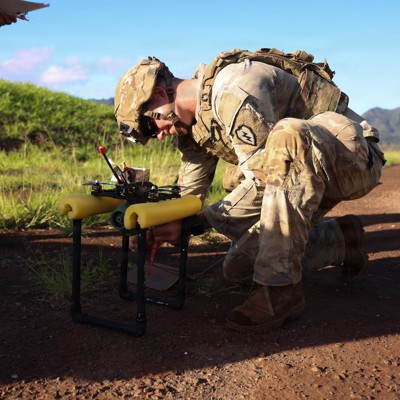
Commercially, XTEND has recently highlighted two contract milestones. First, it announced completion of an $8.8m US government contract with deliveries to US Special Operations Forces, including new equipment training and live-flight exercises for up to 30 operators. Second, it announced delivery of tactical drone systems under an $8m Middle East defence contract, expandable to $25m, for 5,000 systems with options for 10,000 more; the end-customer is not named beyond “a government defence customer in the Middle East”. The tempo of announcements is part of an explicit narrative positioning XTEND as a “global defence platform”, including a reported mobilisation of operators from the US and Latvia to the UK in response to an Israeli Ministry of Defense request.
The counter-UAS angle is strengthened via a partnership with ParaZero Technologies to integrate ParaZero’s DefendAir net-launch capture system with Scorpio 1000. The stated concept is autonomous interception “from detection through capture”, aiming to avoid explosive debris and enable recovery for intelligence exploitation—an argument likely to resonate in Europe given the operational lessons from mass, low-cost one-way attack drones and the increasing demand for non-kinetic, urban-safe counter-drone options.
For Europe, XTEND’s “NDAA-compliant” branding and US market access could make it an attractive supplier or partner for programmes seeking reduced China exposure, particularly amid tightening drone supply-chain policies. However, European stakeholders should stress-test three issues before engagement: export-control and end-use constraints around Israeli/US-linked systems, the maturity and sovereignty implications of XOS-dependent operations, and the political-risk premium created by high-visibility US political family investment—especially if future US regulatory decisions are perceived to favour a narrow set of domestic-aligned manufacturers.
Source: The Drone Girl