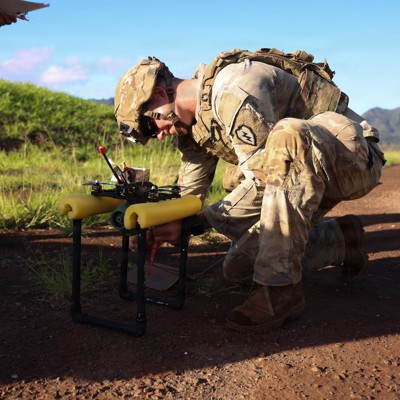
XTEND’s SCORPIO 1000 clears UK paratrooper live-kinetic validation in EW-denied trials
XTEND says UK paratroopers independently validated SCORPIO 1000 live-kinetic strikes in EW/GNSS-denied trials, as its NYSE-bound merger terms loosen.


Key facts
- XTEND says 2 PARA independently operated five SCORPIO 1000 autonomous strike systems during Ex RHINO BIZZ at BATUS in Alberta, Canada.
- XTEND claims its systems were the only autonomous platforms authorised to carry live kinetic payloads in the exercise, operating in heavy EW and GNSS-denied conditions with strikes validated at 3.6 km, 6.5 km and 7.5 km.
- XTEND cites a UK XFAB facility in Swindon and amended reverse-merger terms: NYSE target (XTND), outside close date extended to 31 Oct 2026, and closing cash floor reduced to $60m.
3 minute read
XTEND says it has moved from early-stage demonstration into independent frontline validation with the British Army, after elements of 2nd Battalion, Parachute Regiment (2 PARA) operated five SCORPIO 1000 autonomous strike systems during Ex RHINO BIZZ at the British Army Training Unit Suffield (BATUS) in Alberta, Canada. The exercise, described as a large drone and electronic warfare event, reportedly involved around 350 airborne soldiers from 16 Air Assault Brigade testing “recce-strike” tactics that fuse networked drones, AI-enabled decision support and electronic warfare to detect and engage threats before they can fire.
The operationally relevant claim is that the UAS Platoon conducted missions without active operational support from XTEND staff, suggesting the user interface, training pipeline and mission workflow are approaching a level where non-specialist troops can employ the system under pressure. XTEND further states its platforms were the only autonomous systems authorised to carry live kinetic payloads during the exercise, and that missions were conducted in heavy EW and GNSS-denied conditions. It reports validation of autonomous strike engagements against mock adversaries at 3.6 km, 6.5 km and 7.5 km, a range bracket that—if replicable—speaks to standoff attack utility for light infantry and airborne forces in contested electromagnetic environments.
For European procurement and force development, the UK use-case is a bellwether: it frames autonomy not as a laboratory feature, but as a software-defined layer intended to compress operator training time while sustaining effectiveness under jamming. XTEND positions its proprietary XTEND Operating System (XOS) as the enabler, combining edge AI with human-guided autonomy so standard infantry can supervise complex missions. The company also claims to be building allied-nation “sovereign” industrial footprints, citing a UK XFAB manufacturing and support facility in Swindon intended to satisfy Ministry of Defence compliance and reduce supply-chain friction—an approach aligned with Europe’s current emphasis on local sustainment, security of supply and rapid scaling.
Running in parallel is a high-profile corporate transaction that remains a potential diligence risk signal for European partners: XTEND’s definitive agreement to combine with listed shell company JFB Construction Holdings has been amended, shifting the intended listing from Nasdaq to the NYSE under ticker XTND, extending the outside close date to 31 October 2026 (with further extensions possible) and lowering the minimum closing cash condition from $110m to $60m. XTEND notes strategic backing including investments linked to Eric Trump and Donald Trump Jr. affiliates. For Europe, the implication is twofold: the operational traction with a major NATO user may accelerate interest and competitive pressure in the loitering/precision strike UAS segment, while evolving US capital-market dynamics and politically visible investors can complicate perceptions of supply assurance, governance and long-term programme stability.
Source: The Drone Girl