Zelenskyy installs deep‑strike operator Khmara to stabilise Ukraine defence
Ukraine has appointed ex-special forces general Yevhenii Khmara as defence minister to stabilise procurement and logistics while expanding deep- and mid-strike drone operations against Russia.


Key facts
- Ukraine’s parliament approved Yevhenii Khmara as defence minister with 312 votes in favour and two against.
- Zelenskyy tasked Khmara with fixing defence production, procurement and supply systems and expanding deep- and mid-strike drone campaigns.
- Analysts flagged procurement reform (including a shift to tenders), recruitment reform and stable civil–military relations as key challenges.
3 minute read
Kyiv has moved to close a politically costly leadership crisis at the Ministry of Defence by installing Yevhenii Khmara, a former special forces major general, as defence minister. Parliament approved his candidacy with 312 votes in favour and two against, after President Volodymyr Zelenskyy fired the popular incumbent, Mykhailo Fedorov, amid friction with the senior military command that also culminated in the dismissal of Gen. Oleksandr Syrskyi. The appointment is framed as a bid to restore coherence in wartime management while retaining the innovation-driven direction that Fedorov embodied.
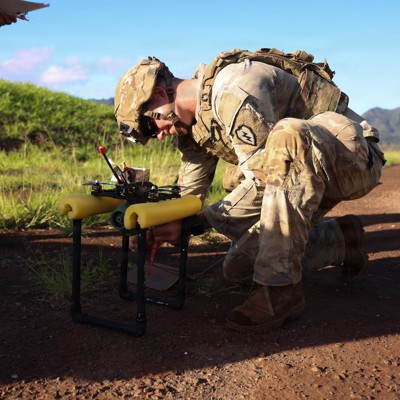
Zelenskyy’s public guidance for Khmara is explicit: make defence production, procurement and logistics measurably more effective, and continue to scale Ukraine’s deep- and mid-strike drone campaigns against Russian military and industrial targets. Khmara echoed this line in parliament, emphasising weapons delivered “in large quantities, on time” and cutting “unnecessary bureaucracy”, while pledging to continue attacks that have disrupted Russian frontline logistics and struck facilities such as refineries. Moscow’s reaction—casting Khmara as a sponsor of sabotage and “terrorist attacks” inside Russia—underlines the strategic signalling around Ukraine’s long-range strike programme and the likelihood of continued Russian political and kinetic counter-pressure.
Operationally, Khmara brings a combat record and relevant institutional experience rather than a political background. The source text credits him with participation in the defence of Kyiv in early 2022, leadership in the operation to liberate Snake Island—critical to securing approaches to Odesa—and direction of deep-strike operations as head of a special operations unit. He also served as acting head of the Security Service of Ukraine (SBU) from January 2023, suggesting familiarity with complex inter-agency coordination.
The immediate performance risks remain structural. Ukrainian analysts cited in the source highlight stalled procurement reforms, including a transition to tenders, as well as the continuing crisis in mobilisation and recruitment that leaves front-line units exhausted while evasion persists. Politically, Khmara’s mandate also includes reducing internal conflict—implicitly learning from the minister–commander clashes that preceded this reshuffle—while he appears to enjoy relatively broad parliamentary goodwill.
For European defence officials and industry, the continuity message matters: Kyiv is signalling that drone and missile innovation, industrial scaling, and tighter procurement execution will remain central despite personnel churn. This sustains European exposure to Ukrainian demand for components, manufacturing know-how, and resilient supply chains for attritable systems, while the stated expansion of deep strikes increases the premium on European air- and missile-defence planning and escalation management as Russia adapts its countermeasures.
Source: Politico.eu